


KENFOX IP & Law Office > Newsletters/ Publications

KENFOX Shares Practical IP Protection Strategies for Chinese Businesses Expanding into Southeast Asia at ASPEC Webinar

[vc_row triangle_shape="no"][vc_column][vc_column_text] On July 8, 2026, as part of the ASPEC Webinar under the "IP Plus" series, Mr. Nguyen Vu Quan, Partner & IP Attorney at KENFOX IP & Law Office, was invited to deliver a presentation entitled "Protecting IP in Southeast Asia: Risks, Case Studies, and Practical Solutions for Chinese Businesses." The webinar attracted significant interest from Chinese businesses and intellectual property professionals. [/vc_column_text][vc_empty_space height="13px"][vc_column_text][/vc_column_text][vc_empty_space height="13px"][vc_column_text] Against the backdrop of Southeast Asia's growing importance as a destination for Chinese companies engaged in manufacturing, distribution, franchising, e-commerce, and long-term investment, Mr. Nguyen Vu Quan emphasized that market expansion inevitably brings substantial intellectual property...

Continue reading

Similar Trademarks in the Same Class Are Not Necessarily Refused in Their Entirety in Vietnam: Practical Notes on Trademark Examination in Vietnam

[vc_row triangle_shape="no"][vc_column][vc_column_text]One of the most common questions raised by trademark owners when filing trademark applications in Vietnam is: “If the proposed trademark is similar to an earlier registered trademark, and both designate goods or services in the same Nice Class, will the application automatically be refused?” According to practice in Vietnam, the answer is: not necessarily. The fact that two trademarks belong to the same class of goods/services according to the Nice Classification is an important factor, but it is not determinative and does not automatically mean that the goods or services are identical or similar. Conversely, in many cases, goods/services belonging...

Continue reading

From Europe to Vietnam – Three Questions for Determining the Copyright Eligibility of Functional Products as Works of Applied Art

[/vc_column_text][vc_empty_space height="13px"][vc_column_text] Download In traditional legal thinking, functional products - ranging from sandals and handbags to perfume bottles - have generally been viewed as falling within the scope of industrial design protection rather than copyright. However, the judgment rendered on 12 November 2025 by the District Court of Midden -Nederland in Birkenstock v. Scapino (Case No. C/16/577582 / HA ZA 24-336) marks a significant turning point. The Court affirmed that even products commonly perceived as being primarily functional, such as sandals, may qualify for copyright protection where their appearance results from the designer's free and creative choices and reflects the designer's personal...

Continue reading

Asplund v. Mio: The Real-World Test After Cofemel – When Does a Dining Table Become a Copyright-Protected “Work”?

[vc_row triangle_shape="no"][vc_column][vc_column_text] Download While the landmark Cofemel v. G-Star ruling officially rejected the notion that applied art products are only eligible for copyright protection if they achieve a "high level of artistic merit," current litigation practice raises a far more complex question - a new gray area: Where lies the boundary between an "original creation" and a "common variant" in the furniture sector, where utilitarian function inherently restricts a designer's creative freedom? In disputes over the copying of furniture, decorative lighting, cabinetry, and similar designs, traditional legal thinking is often driven by an industrial design approach: the parties, and even the Courts, tend...

Continue reading

USM v. Konektra: Does a Functional Product Require a Higher Degree of Creativity to Merit Copyright Protection?

Download Conventional legal thinking often takes for granted that “technical product systems”—such as modular furniture sets, replacement parts, or industrial machinery—fall primarily within the regulatory scope of Design Law or Patent Law. Right holders rarely have the fortitude to opt for the copyright mechanism, largely due to a deeply ingrained perception: for applied products, in order to prevent "overlap" with design law, the law must establish a higher, more stringent "creativity threshold" compared to purely literary and artistic works. Against this backdrop, KENFOX IP & Law Office will analyze the case of 1. USM v. Konektra - Liệu sản phẩm mang tính...

Continue reading

Cancellation of Bad Faith Trademark Registration in Laos: The PINDUODUO Case

[vc_row triangle_shape="no"][vc_column][vc_column_text] Download Many jurisdictions in Southeast Asia operate on a first‑to‑file basis for trademark protection. In Laos, the party who first files a trademark application generally secures priority regardless of whether it has used the mark. This rule creates a vulnerability when opportunistic registrants obtain local registrations for internationally known brands before the actual owners enter the market. However, a recent landmark decision by the Lao Department of Intellectual Property (DIP) highlights that the first-to-file rule is not an absolute shield for opportunism. Represented by KENFOX (LAO) IP Service CO., LTD, the true owner of the global e-commerce giant - Shanghai Xunmeng...

Continue reading

Monolith Law Office (Japan) and KENFOX strengthen international legal cooperation

Success or failure in providing legal services in foreign markets heavily depends on choosing the right partner. For companies aiming to expand their reach and serve their customers in foreign markets, finding and partnering with a local partner is not only a strategic move but also is the deciding factor for their success or failure in that market. In a legal environment like Vietnam, where regulations are becoming increasingly diverse, changing and complex, the cost of services is no longer considered a top priority. The most important thing for international businesses is not the number of offices or personnel that...

Continue reading

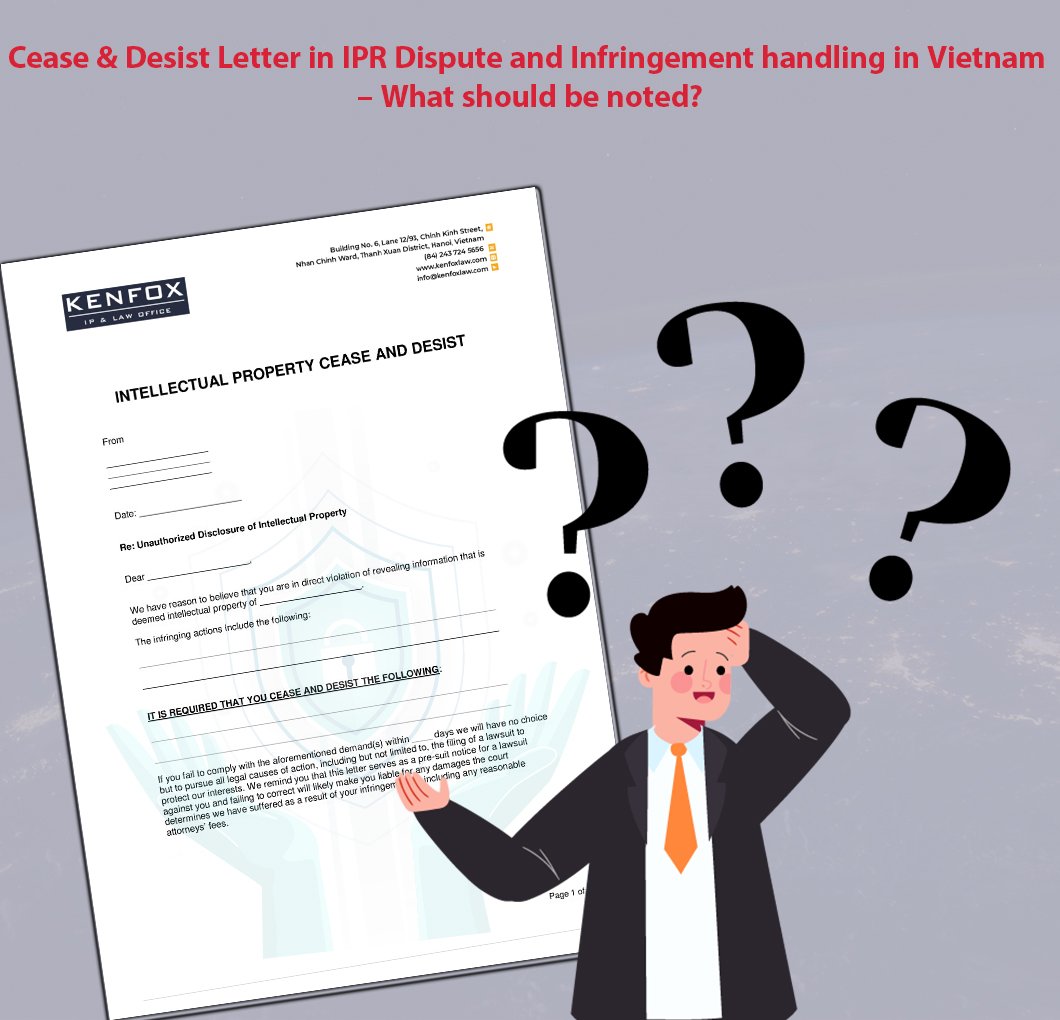
Cease & Desist Letter in IPR Dispute and Infringement handling in Vietnam – What should be noted?

Cease & Desist Letter - KENFOX

Download Cease & Desist Letter (C&D Letter) on infringement of intellectual property rights (IPR) is considered a "soft" measure that is flexibly used by various rights holders to cope with alleged IPR infringements. In some cases, sending a C&D Letter instead of requesting intervention from the Vietnamese enforcement authorities seems to be effective as the infringement is immediately terminated. But all this may still be just the top of the iceberg. Sending a C&D Letter to the alleged infringer can sometimes put the right holder into unforeseen difficulties. From the perspective of the party that is alleged to be infringing on...

Continue reading

Patent registration in Laos – 6 critical considerations

Chinese Download Introduction Recently, the Department of Intellectual Property of Laos (DIP) granted the patent application titled "Printing apparatus and method thereof" filed by the Thai patent holder under the advice and representation of KENFOX IP & Law Office, with the following details: Patent: Application date: Application No.: Registration: Holder: Address: Printing device and method thereof February 5, 2016 23 August 1, 2022 MR. SUWATCHAI PROMBUT 36 Soi Nakniwat 21 Yak 2-1, Nakniwat Road, Ladprao, Ladprao, Bangkok, Thailand. Six critical considerations when registering a patent in Laos 1. Rights and interests for patent owners in Laos A monopoly granted by a patent is a territorial right, which means that an invention is only protected inside the territory of...

Continue reading