Cancellation of Bad Faith Trademark Registration in Laos: The PINDUODUO Case

[vc_row triangle_shape="no"][vc_column][vc_column_text] Download Many jurisdictions in Southeast Asia operate on a first‑to‑file basis for trademark protection. In Laos, the party who first files a trademark application generally secures priority regardless of whether it has used the mark. This rule creates a vulnerability when opportunistic registrants obtain local registrations for internationally known brands before the actual owners enter the market. However, a recent landmark decision by the Lao Department of Intellectual Property (DIP) highlights that the first-to-file rule is not an absolute shield for opportunism. Represented by KENFOX (LAO) IP Service CO., LTD, the true owner of the global e-commerce giant - Shanghai Xunmeng...

Continue reading

Whether Functional Products Are Eligible for Protection as ‘Works of Applied Art’ in Vietnam?

[vc_row triangle_shape="no"][vc_column][vc_column_text] [/vc_column_text][/vc_column][/vc_row][vc_row triangle_shape="no"][vc_column][vc_column_text]A “functional product”, in simple terms, is a product that serves a practical utilitarian purpose (e.g., household items, electronic devices, technical tools, etc.). For many years, prevailing “orthodox” legal thinking in Vietnam has tended to classify functional products (useful articles) such as bicycles, furniture, handbags, perfume bottles, and coffee machines squarely within the realm of industrial designs. From this practice emerged an almost unassailable assumption: Functional products cannot qualify as “works” and therefore are not eligible for copyright protection. International practice, however, demonstrates the opposite. French courts have recognized the Hermès Birkin and Kelly handbags as works of art...

Continue reading

Cofemel v. G-Star: The new standard of the European Court of Justice – Can a pair of jeans be considered a “work of art”?

Download

Conventional legal thinking often defaults to the premise that “functional products”—such as a pair of jeans, a pair of sandals, a fashion handbag, or a perfume bottle—fall primarily within the scope of Industrial Design protection. Rights holders rarely consider the mechanism of Copyright, due to the misconception that the form of mass-produced products can hardly meet the threshold of a “work” or a “work of applied art” to warrant protection.

KENFOX IP & Law Office will analyze the case of Cofemel v. G-Star to elucidate how the Court of Justice of the European Union (CJEU) established a new standard in viewing applied designs from a Copyright perspective. The case not only poses the question of whether a pair of jeans—traditionally viewed as a common consumer product—can be recognized as a “work,” but also opens up a broader debate regarding the boundary between utility and creativity. From this, businesses can conceptualize the prerequisites that must be satisfied to determine when a “functional product” can still be protected under copyright law, alongside the industrial design protection mechanism.

1. Background of the incident

G-Star Raw (G-Star Raw CV) is a renowned Dutch fashion company, founded in 1989 in Amsterdam. The brand is globally famous for its denim products (jeans) and its raw, rugged design style. Cofemel (Cofemel – Sociedade de Vestuário SA) is a Portuguese fashion company. It owns the fashion brand Tiffosi, which is highly popular in Portugal and Spain, specializing in the manufacture and trade of ready-to-wear apparel.

In 2013, G-Star Raw initiated legal proceedings against Cofemel, alleging that Cofemel had copied its jeans and t-shirt models named “ARC” and “ROWDY”. The Plaintiff, G-Star, argued that the “ARC” and “ROWDY” models were not merely everyday apparel, but rather the culmination of an intentional, original creative process, thereby qualifying them as “works” eligible for protection under copyright law. Conversely, the Defendant, Cofemel, countered that clothing serves a functional purpose, and such apparel designs cannot be classified as “works” entitled to such protection. Additionally, Cofemel argued that to be eligible for copyright protection, a design must transcend into “art” and possess a specific “aesthetic value” or “artistic effect”.

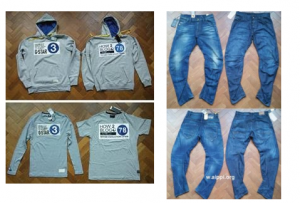
Image source : www.alamy.com/ www.sgcr.pt and www.aippi.org

The Portuguese Court of First Instance ruled in favor of G-Star, recognizing the ARC and ROWDY models as “works,” ordering Cofemel to cease its infringing acts, and directing the disgorgement of profits. Cofemel appealed the judgment to the Tribunal da Relação de Lisboa (Court of Appeal, Lisbon, Portugal), which subsequently affirmed the lower court’s decision.

The case was further appealed to the Supreme Court of Portugal. This apex court acknowledged that G-Star’s designs were the result of a creative design process featuring specific formative elements, and that Cofemel had incorporated several of those elements into its own products. However, the Supreme Court faced a legal dilemma: the Portuguese Copyright Act did not explicitly define the requisite threshold of “originality” for this category of designs, and judicial practice reflected the view that an “aesthetic effect” or “high artistic value” was required to trigger protection.

Consequently, the Supreme Court of Portugal referred a question to the Court of Justice of the European Union (CJEU) for a preliminary ruling in Case C-683/17, seeking clarification on whether Article 2(a) of Directive 2001/29/EC (the InfoSoc Directive) permits a Member State to reserve copyright protection for designs that produce a “specific aesthetic effect,” in addition to the criterion of “originality”.

Bad-Faith Trademark Filings in Vietnam: What’s new in the IP Law 2025?

[vc_row triangle_shape="no"][vc_column][vc_column_text]Vietnam’s first-to-file trademark system has increasingly been exploited by professional trademark squatters. In practice, certain individuals and companies have filed dozens, or even hundreds, of trademarks that appear to copy or imitate marks already used by foreign brand owners, overseas manufacturers, franchise chains, online sellers, or businesses preparing to enter Vietnam. These filings are often not made for genuine commercial use. Rather, they are made to wait for a payoff. Once registered, that mark may be used not only as a passive obstacle to registration, but also as an active commercial weapon: to demand payment, block distribution, pressure local partners,...

Continue reading

NGB CORPORATION VISITS KENFOX TO EXPLORE STRATEGIC COOPERATION IN PATENT PROTECTION AND IP ENFORCEMENT

[vc_row triangle_shape="no"][vc_column][vc_column_text] On June 8, 2026, KENFOX IP & Law Office had the pleasure of welcoming Mr. Hiroyoshi Teraoka, Representative of NGB Corporation’s Thailand Office, for an official visit and working session in Hanoi. The meeting provided an excellent opportunity for both parties to exchange insights on patent prosecution, intellectual property (IP) protection and enforcement, and potential avenues for strategic collaboration to support Japanese businesses seeking effective IP protection in Vietnam. NGB Corporation – Nearly Seven Decades of Excellence in Intellectual Property Services During the meeting, Mr. Hiroyoshi Teraoka introduced NGB Corporation, one of Japan’s leading intellectual property service providers. Established in 1959,...

Continue reading

STRENGTHENING INTELLECTUAL PROPERTY PROTECTION IN VIETNAM: Visit and Working Session of HongYuan Intellectual Property Law Firm at the KENFOX Office

[vc_row triangle_shape="no"][vc_column][vc_column_text] On May 22, 2026, KENFOX IP & Law Office was honored to welcome representatives of HongYuan Intellectual Property Law Firm for a visit and working session at the KENFOX office in Hanoi. The meeting focused on key issues relating to the protection and enforcement of intellectual property rights in Vietnam, including legal reforms, the effectiveness of handling infringement acts, investigative infrastructure, and enforcement coordination mechanisms among competent authorities. Key Discussion Topics During the meeting, KENFOX experts provided in-depth analysis and practical insights into the intellectual property landscape in Vietnam, including: Legal Framework & Enforcement: Updates on the latest amendments to intellectual...

Continue reading

KENFOX is honored to act as the intellectual property (IP) representative for Fischer-a renowned German brand of steel adhesives and chemical anchors-in handling IP infringements and counterfeit goods in Vietnam

How to Identify Genuine Fischer Injection Mortars Fischer representatives recommend that users carefully check the packaging, cartridge structure, and mixing mechanism to distinguish genuine chemical anchor adhesives from counterfeit products appearing on the market. Fischer is a trademark owned by fischerwerke GmbH & Co. KG, a company headquartered in Germany and operating in the field of anchoring solutions, installation systems, and engineering materials used in construction and industry. According to the brand representative, chemical anchor adhesives are products that require strict technical standards because they directly affect the bonding capability and load-bearing capacity of anchoring systems in construction works. Therefore, the use of...

Continue reading

Overcoming the Territoriality Trap: How FUMARI Blocked a Bad-Faith Trademark Filing in Laos Without Local Registration

[vc_row triangle_shape="no"][vc_column][vc_column_text] Download The Department of Intellectual Property of Laos (“Laos DIP”) recently issued a Notice sustaining an opposition against Trademark Application No. 50354 for “FUMARI” in Class 34, filed by Xuanfeng Biotechnology Sole Co., Ltd. In this matter, KENFOX IP & Law Office represented Fumari Inc. to challenge the adverse party's mark, steering the case to a successful outcome. In its Notice, the Laos DIP confirmed that, following consideration of the opposition based on the relevant reasons and evidence submitted, the opposition was sustained. As a result, the opposed application will not proceed to the substantive examination stage. This is a significant outcome...

Continue reading

KENFOX Attends the INTA Annual Meeting 2026 in London: Expanding Perspectives, Strengthening Global Connections, and Enhancing Professional Capacity

From 2 to 6 May 2026, a three-member delegation from KENFOX IP & Law Office attended the INTA Annual Meeting 2026 in London - one of the world’s largest and most influential events in the field of intellectual property (IP), bringing together thousands of lawyers, professionals, corporations, and IP organizations from numerous jurisdictions....

Continue reading

China: CNIPA Proactively Refused and Invalidated Ambiguous-Concept Trademarks Such as “Zero Sucrose” and “Farm-Raised”

Download Many enterprises do not design trademarks to distinguish their goods from those of others - the core function of a trademark. Instead, they exploit the system to "privatize" common industry terminology. They treat the trademark registration certificate as a "legal free pass" to monopolize advertising messages (such as "Zero Sugar" or "Farm-Raised"). Armed with these registered marks, they can then turn around and restrict competitors from using descriptive terms that everyone should inherently have the right to use. Cloaking vague and exaggerated descriptive terms under the guise of an "exclusively registered trademark" creates a false veneer of credibility. Consumers are easily...

Continue reading