






Two Lawsuits over a Pair of Shoes in Denmark and the United States: Which Strategy Best Protects Functional Products under Copyright Law?
The legal battle between Ganni A/S—the Danish fashion brand that rose to prominence through the “Scandi cool” movement—and Steve Madden, Ltd., the American footwear company renowned for its trend-driven business model, has emerged as one of the most significant fashion design disputes of 2024–2025. Centered on Ganni’s “Buckle Ballerina” shoe and Steve Madden’s “Grand Ave” model, the dispute extends far beyond the similarity between two products. Instead, it serves as an important test of the scope of copyright protection for functional products, particularly as parallel proceedings have unfolded within two of the world’s most influential legal systems: the European Union and the United States.
Ganni’s resounding success in Denmark – where the court recognized the shoe design as a work of applied art – stood in sharp contrast to the dispute’s quiet conclusion in the United States, where Ganni withdrew its claims before the court had an opportunity to rule on the merits. This divergence gives rise to a central question: Why did the same design lead to two fundamentally different legal outcomes?
This article by KENFOX IP & Law Office examines the dispute through the lens of the fundamental differences between the European Union’s originality standard in copyright law and the United States’ useful article doctrine. The Madden v. Ganni dispute thus provides a compelling illustration of the “transatlantic copyright battle,” revealing how these two legal systems conceptualize—and protect—aesthetic creativity embodied in products that simultaneously possess artistic value and utilitarian function.
I. Background
1. The Parties to the Dispute
Ganni A/S is a Danish fashion company founded in Copenhagen in 2000 by Frans Truelsen, originally as a cashmere label. In 2009, the brand was acquired by Nicolaj Reffstrup, who became Chief Executive Officer, and Ditte Reffstrup, who assumed the role of Creative Director. Under their leadership, Ganni was repositioned as a contemporary ready-to-wear fashion brand occupying the space between fast fashion and haute couture. Since then, the company has experienced significant growth in both revenue and global market presence, establishing dozens of retail stores across Europe and the United States while expanding an extensive international distribution network.
Ganni is widely regarded as one of the brands that has come to define the “Scandi cool” movement—a new generation of Nordic fashion that departs from austere minimalism in favor of a youthful, vibrant aesthetic combining femininity, irreverence, and everyday wearability. The brand has gained substantial influence across social media and among fashion influencers, and has been worn by celebrities including Bella Hadid, Miley Cyrus, and Emma Chamberlain. Today, Ganni operates multiple flagship stores in Copenhagen and more than 25 retail stores across the United States.
Steve Madden, Ltd. is an American footwear and fashion accessories company founded in 1990 by designer Steve Madden with an initial investment of approximately US$1,100. The company began as a small operation in Queens, New York, where Madden designed platform shoes and sold them to retail stores in Manhattan. From these modest beginnings, Steve Madden developed into one of the leading footwear brands in the United States, recognized for its trend-driven designs and rapid response to emerging fashion trends.
The company was incorporated in New York in 1990 and subsequently reincorporated in Delaware in 1998. It has been publicly traded on the Nasdaq since 1993 and is currently headquartered in Long Island City, New York. Today, Steve Madden operates hundreds of retail stores worldwide and manages a broad portfolio of brands, including Dolce Vita, Betsey Johnson, Blondo, and BB Dakota, as well as numerous licensed brands.
Steve Madden is widely recognized as one of America’s leading trend-driven footwear companies. Its business model is built on the ability to identify, adapt, and rapidly commercialize emerging fashion trends, bringing trend-inspired designs to the mass market through an extensive network of company-owned retail stores, major department store partners, and international distribution channels.
2. The Disputed Shoe Designs
“Buckle Ballerina” (Ganni). The Buckle Ballerina is a pointed-toe ballet flat featuring a slingback construction and a low heel. Its sole adopts a relatively chunky, squared-off profile, giving the shoe a distinctive and slightly rugged appearance. Two wide straps extend across the vamp, each secured with metal buckles and eyelets that evoke a punk-inspired aesthetic. The design is offered in glossy leather and a variety of colorways. The Danish court noted the model’s considerable commercial success, recording sales exceeding DKK 13 million in Denmark alone, as well as its substantial media exposure and market recognition.
“Grand Ave” / “GRAYA” / “SANDRIA” (Steve Madden): Viewed as a whole, these models closely replicate the overall aesthetic composition of Ganni’s Buckle Ballerina, featuring a pointed toe, a slingback strap, a low heel, two wide straps across the vamp secured with metal buckles and eyelets, a glossy leather upper, and a similar color palette. “Grand Ave” was marketed in Europe, including Denmark, whereas “GRAYA” and “SANDRIA” were the corresponding models offered in the United States. Steve Madden maintained that these designs reflected prevailing market trends rather than constituting copies of Ganni’s Buckle Ballerina.
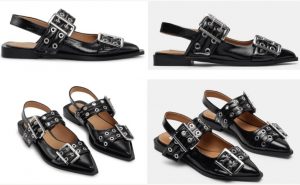
Figure 1. Ganni’s Buckle Ballerina shoe (left) and Steve Madden’s Grand Ave shoe (right)
3. C. The First Lawsuit: Ganni A/S v. Steve Madden, Ltd. (Denmark)
Registration and Initial Enforcement Strategy: In 2023, Ganni obtained a Registered Community Design (RCD) for its “Buckle Ballerina” shoe design in the European Union. At the same time, Ganni initiated proceedings against Steve Madden, Ltd. before the Danish Maritime and Commercial High Court, seeking:
- A declaration that the Buckle Ballerina shoe constitutes a copyright-protected work of applied art;
- A declaration that Grand Ave infringed Ganni’s copyright and violated the Danish Marketing Practices Act;
- A permanent injunction prohibiting Steve Madden, Ltd. from manufacturing, marketing, importing, exporting, or otherwise commercializing the Grand Ave shoe in Denmark..
Judgments of the Danish Courts (2024, affirmed on appeal in 2025): In August 2024, the Danish Maritime and Commercial High Court ruled in favor of Ganni. In March 2025, the High Court of Eastern Denmark upheld the judgment on appeal, affirming that:
[i] Buckle Ballerina constitutes a work of applied art: The Danish court applied the “author’s own intellectual creation“ standard, consistent with the case law of the Court of Justice of the European Union (CJEU), particularly Infopaq and Cofemel. Although the individual design elements—such as the pointed toe, straps, buckles, and sole—were not themselves novel, their particular combination produced an overall appearance that had not previously existed and reflected the designer’s free and creative choices. The court emphasized the distinctive juxtaposition of a soft, feminine ballet-flat silhouette with a chunky sole, wide straps, and metal buckles that conveyed a punk-inspired, contemporary aesthetic.
[ii] Grand Ave constitutes an impermissibly close copy: The court compared the overall visual impression created by the two designs, focusing on features including the pointed-toe silhouette, slingback construction, chunky sole, two wide straps across the vamp, metal buckles and eyelets, glossy leather finish, and comparable color combinations. It concluded that the majority of these elements served no technical function but were instead purely aesthetic design choices. Accordingly, the minor differences in the arrangement and proportions of certain details were insufficient to dispel the overall impression of substantial similarity between the two shoe designs.
[iii] Combined application of copyright law and marketing law: In addition to finding copyright infringement, the court held that Grand Ave violated the Danish Marketing Practices Act. It reasoned that Steve Madden had adhered so closely to Ganni’s design that it obtained an unfair competitive advantage by exploiting the commercial appeal and market recognition of the Buckle Ballerina without making sufficient independent creative contributions.
Outcome: Steve Madden was prohibited from selling, distributing, importing, or exporting the “Grand Ave” shoes in Denmark. The judgment has been widely recognized as the first time a Danish court explicitly held that a specific shoe design qualifies for copyright protection. In other words, in Denmark, the “Buckle Ballerina” is no longer regarded merely as a fashion product; rather, it has been elevated to the status of a copyright-protected work of applied art.
4. D. The Second Lawsuit: Steve Madden, Ltd. v. Ganni A/S (United States)
While facing defeat in Denmark, Steve Madden opened a new front in the United States by initiating litigation against Ganni A/S.
Complaint Filed in the U.S. District Court for the Eastern District of New York: Steve Madden, Ltd. v. Ganni A/S, No. 1:24-cv-04946-BMC.
In July 2024, Steve Madden commenced an action in the United States District Court for the Eastern District of New York, demanding a jury trial. The complaint sought, among other relief: (i) A declaratory judgment that the GRAYA and SANDRIA shoe designs (the U.S. market counterparts to Grand Ave) did not infringe any copyright, patent, trade dress, or unfair competition rights asserted by Ganni; (ii) Damages for tortious interference with business relations and libel, alleging that Ganni had sent cease-and-desist letters to retailers and online platforms – including Nordstrom, Dillard’s, ASOS, and Zalando – urging them to cease selling Steve Madden’s products; and (iii) A permanent injunction prohibiting Ganni from engaging in what Steve Madden characterized as conduct aimed at “stifling competition.
Steve Madden’s Arguments: In its Complaint and subsequent Amended Complaint, Steve Madden advanced a markedly different narrative of the dispute, arguing that:
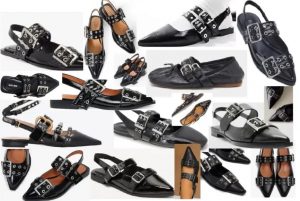
- As a matter of market reality: Steve Madden argued that ballet flats, slingback designs, wide straps, metal buckles, eyelets, and glossy leather finishes are commonplace features in the footwear industry. To support this position, the company identified nearly 100 comparable shoe designs available on the S. market, contending that Ganni A/S could not monopolize a style that had already become ubiquitous within the fashion industry.
- As a matter of U.S. intellectual property rights: Steve Madden argued that Ganni held no S. copyright registration, design patent, trademark, or trade dress protection for either the Buckle Ballerina or the Two-Strap shoe design. Consequently, Ganni’s cease-and-desist letters asserting “worldwide copyright and design rights” and threatening legal action against Steve Madden’s customers exceeded the scope of rights recognized under U.S. law.
Ganni’s Response in the United States: A Strategic Retreat and the Abandonment of Its IP Claims
In November 2024, Ganni filed its Answer together with several affirmative defenses. At the same time, however, it took two significant procedural steps: (i) it acknowledged before the U.S. court that it “does not own or control any U.S. copyright, trademark, trade dress, or patent rights” in relation to the designs at issue; and (ii) it executed and filed a Covenant Not to Sue, irrevocably undertaking not to bring any intellectual property claims in the United States against Steve Madden, Ltd. or its customers based on those asserted rights.
Outcome:
- The claims for declaratory relief of non-infringement became effectively moot, as Ganni had formally acknowledged that it possessed no enforceable U.S. intellectual property rights on which such infringement claims could be based.
- The focus of the litigation shifted to Steve Madden’s claims for tortious interference and libel—that is, causes of action grounded in unfair competition and tort law—raising the prospect that the dispute would ultimately be resolved through an out-of-court settlement.
- With respect to copyright protection for the shoe designs, the U.S. court was left with neither the opportunity nor the necessity to reach the merits. As a result, the case concluded on procedural grounds without producing a substantive judicial ruling on the copyrightability or alleged infringement of the designs.
II. E. The European Union and the United States: Two Legal Systems, Two Distinct Approaches to the Copyright Protection of Fashion Designs
To explain why Ganni achieved a decisive victory in Denmark yet opted for a strategic withdrawal in the United States, the dispute must be examined through the distinct legal frameworks governing originality and functional products in the two jurisdictions.
1. EU: A Unified Standard for “Works” and an Open Approach to Fashion
(a) The EU Standard of Originality
According to the case law of the Court of Justice of the European Union (CJEU), particularly in decisions such as Infopaq, Painer, and Levola, a subject matter qualifies as a “work” if it satisfies two conditions:
- Originality: The subject matter must constitute the author’s own intellectual creation (AOIC). This requires that:
- The author must have had scope to make free and creative choices during the design process.
- The design must bear the author’s personal touch, reflecting their individual preferences, style, or distinctive approach to aesthetic expression.
- Where the product’s appearance is entirely dictated by technical function, utilitarian requirements, or other mandatory constraints, leaving no room for free and creative choices, it cannot qualify as a “work.”
- Identifiability: The subject matter must be sufficiently precise and objectively identifiable. In other words, the protected subject matter must have a form that is defined with sufficient precision and objectivity, enabling competent authorities, courts, and third parties to clearly identify the scope of protection.
In Cofemel (Case C-683/17)—a dispute arising directly from the fashion industry – the CJEU went a step further by holding that: (i) Member States may not impose additional national requirements – such as a requirement that a design possess a high degree of aesthetic value, exceptional artistic merit, or similar criteria – as a condition for copyright protection of fashion designs or other works of applied art; and (ii) In other words, there is only one copyright standard – AOIC (the author’s own intellectual creation) – applicable to all categories of works, including works of applied art, even where the product also serves a functional purpose.
Accordingly, in principle, if a shoe—including its three-dimensional shape—is the result of the author’s free and creative choices, rather than being dictated by technical function, it may qualify as a copyright-protected “work.”
(b) Ganni Through the Lens of Cofemel
In its judgment concerning the “Buckle Ballerina” shoe, the Danish court applied the reasoning of Cofemel in a clear, orthodox, and consistent manner:
(i) It acknowledged that the individual design elements—such as the pointed toe, sole, straps, and buckles—were not novel in themselves;
(ii) However, it emphasized that copyright subsists in the creative combination of those elements, particularly: the contrast between the soft, feminine ballerina silhouette and the angular, rigid sole and heel; the wide straps, oversized buckles, and metal eyelets, which impart a distinctive punk-inspired aesthetic; and the designer’s freedom to choose the shapes, proportions, and placement of these design features. On that basis, the court concluded that the overall design reflected the designer’s free and creative choices and therefore qualified as an original work eligible for copyright protection.
- The design is not dictated by functional considerations, as a shoe can perform the same utilitarian function while taking an entirely different form.
- The overall appearance reflects the designer’s own aesthetic vision and creative judgment, and therefore satisfies the author’s own intellectual creation (AOIC) standard.
Significantly, the court did not require an exceptionally high degree of originality, nor did it demand that the design possess exceptional artistic value or aesthetic merit. Rather, it held that a modest level of creativity is sufficient, provided that the design genuinely reflects the author’s own free and personal creative choices. This reasoning follows the trajectory established in Cofemel, reinforcing the EU’s increasingly copyright-friendly approach to fashion design.
As a result, within the EU legal framework, the “Buckle Ballerina” shoe had a strong legal basis for being recognised as a copyright-protected work. Consequently, the “Grand Ave” shoe was found to constitute an infringing copy of that protected work.
2. United States: The Useful Article Doctrine and the Separability of Functional Elements
(a) The Legal Framework: 17 U.S.C. § 101 and Star Athletica
Under 17 U.S.C. § 101, pictorial, graphic, and sculptural works embodied in a useful article—such as shoes or clothing—are eligible for copyright protection only to the extent that their artistic features:
- Can be identified separately from the article’s utilitarian aspects (separate identification); and
- Can exist independently of the article’s utilitarian function (independent existence), meaning that, if conceptually separated from the useful article, the artistic feature could exist on its own as a two- or three-dimensional work of art, without performing the utilitarian function of the article.
In Star Athletica, L.L.C. v. Varsity Brands, Inc., 580 U.S. 405 (2017), the Supreme Court of the United States (SCOTUS) articulated a two-part test for determining when artistic features incorporated into a useful article are eligible for copyright protection. Under this test, a design element is copyrightable only if it:
- Recognised that the decorative features of the cheerleading uniforms – such as the chevrons, stripes, and colour-blocking patterns – could be identified separately from the garments’ utilitarian function and therefore qualified for copyright protection.
- At the same time, however, emphasised that the shape, cut, and dimensions of the garments – that is, their industrial design or overall configuration – are not protected by copyright.
In summary, U.S. copyright law adopts a more cautious approach to protecting the overall shape of functional products through copyright. Protection is generally confined to separable artistic features, rather than extending to the product’s three-dimensional configuration as a whole.
Accordingly, the primary focus of copyright protection lies on surface ornamentation – such as decorative graphics, patterns, prints, or other pictorial designs – rather than on the three-dimensional form or overall shape of functional products such as shoes or clothing.
(b) Ganni’s Legal Position in the United States in the Steve Madden Dispute
In theory, Ganni could have sought protection for the pattern, the arrangement of the straps, buckles, and eyelets as copyrightable pictorial, graphic, or sculptural features. Alternatively, it could have pursued protection under trade dress law by claiming that the product’s overall appearance functions as a source identifier, provided that it could establish secondary meaning – namely, that consumers associate the design with Ganni as its commercial source.
In reality, however, the case record shows that Ganni had none of the following U.S. intellectual property rights in relation to the Buckle Ballerina design:
- A U.S. copyright registration;
- A U.S. design patent; or
- A U.S. trademark or trade dress registration.
During the litigation, Ganni formally acknowledged before the U.S. court that it did not own any U.S. intellectual property rights in the designs at issue. It also executed a Covenant Not to Sue, irrevocably undertaking not to bring any infringement action against Steve Madden in the United States based on those rights.
The underlying reasons may be explained as follows: (i) A high legal threshold and inherent uncertainty. To obtain copyright protection for the overall shape of the shoe, Ganni would have had to demonstrate that the design contains separable artistic features within the meaning of Star Athletica—a requirement that is far from straightforward for a three-dimensional product design. Likewise, to secure trade dress protection, Ganni would have needed to establish secondary meaning in the U.S. market, even though the Buckle Ballerina had not yet achieved the same iconic status or level of consumer recognition in the United States as it had in Europe. (ii) Costs, risks, and the potential precedential impact. Pursuing the litigation to a final judgment in the United States would likely have been costly and would have exposed Ganni to the risk that a U.S. court might hold that the design is not entitled to intellectual property protection, thereby creating an unfavorable precedent for Ganni’s broader strategy of seeking global protection for its designs. By contrast, voluntarily relinquishing its U.S. intellectual property claims—at least for the purposes of the litigation—allowed Ganni to contain its litigation risk, preserve its victory in Denmark and the EU, and avoid the possibility of a U.S. judgment adopting a clearly contrary approach that could later be invoked against it in future disputes.
III. Comparing the Standard of Originality for Functional Products in the European Union and the United States
1. European Union: The “Author’s Own Intellectual Creation” (AOIC) Standard – Emphasising Creative Freedom with Limited Focus on Functional Separability
Under EU law, following the CJEU’s decisions in Infopaq and Cofemel, the originality of a work of applied art is assessed on the basis of two fundamental principles: (i) The work must not be a mere reproduction of pre-existing subject matter – that is, it must not result from purely mechanical copying; and (ii) The work must reflect the author’s free and creative choices, meaning that the designer had genuine creative freedom among multiple possible design solutions and that the resulting product expresses the author’s own intellectual creation and personal creative vision.
In the Ganni litigation before the Danish courts, the court did not attempt to separate the shoe’s functional elements from its aesthetic features. Instead, it asked whether the designer’s selection, arrangement, combination, and juxtaposition of existing design elements – such as the pointed toe, straps, buckles, and other features – reflected independent creative choices. Once the answer was found to be yes – because the designer enjoyed a significant degree of creative freedom and the overall combination embodied a distinctive aesthetic vision – the court recognised copyright protection for the shoe’s overall three-dimensional form as a work in its own right.
A noteworthy aspect of the EU approach is that the principal limitation lies in the requirement that the design must not be dictated entirely by technical function. This reflects the reasoning in Brompton Bicycle: where the shape of a product is solely the inevitable result of its technical function, it cannot qualify for copyright protection. Once this functional constraint is overcome, however, the AOIC standard is applied relatively flexibly, making it easier for fashion designs to be recognised as copyright-protected works, provided that they embody the author’s free and creative choices.
2. United States: The “Modicum of Creativity” Standard Combined with the Separability Requirement – A More Restrictive Approach to the Three-Dimensional Shape of Functional Products
In principle, the United States likewise adopts a very low threshold of originality. In Feist Publications, Inc. v. Rural Telephone Service Co., 499 U.S. 340 (1991), the U.S. Supreme Court held that a work need only possess “a modicum of creativity” to satisfy the originality requirement. However, in the case of useful articles, the decisive issue is not originality alone, but rather the separability test under 17 U.S.C. § 101 and the Supreme Court’s decision in Star Athletica. In practical terms:
- Originality is considered only after the court has determined that one or more artistic features can be identified separately and exist independently as a two- or three-dimensional work of authorship.
- For products such as footwear, whose overall shape is closely intertwined with their utilitarian function, identifying separable artistic features is often difficult, creating significant legal uncertainty for plaintiffs.
In the context of the Steve Madden v. Ganni dispute, this meant that even if Ganni sought to argue that the arrangement of the straps, buckles, and eyelets constituted a separable artistic pattern, it would still have been required to: (i) demonstrate that those design features satisfy the separability requirement under U.S. copyright law; and (ii) overcome Steve Madden’s factual argument that numerous other shoes on the U.S. market incorporate similar arrangements of straps, buckles, and eyelets, thereby undermining any claim that those features constitute protectable artistic expression.
Potential Risks for Ganni:
- Even if the court were to find that the relevant design features satisfy the separability requirement, it could still conclude that they lack sufficient originality, particularly in light of the abundance of similar designs already available in the U.S. market.
- Such a ruling would amount to a direct judicial finding that Ganni’s shoe design does not qualify for intellectual property protection in the United States – a result that, from a strategic perspective, Ganni was unlikely to be willing to risk.
Ganni’s decision to disclaim any U.S. intellectual property rights and to execute a covenant not to sue effectively allowed it to withdraw from the playing field before the court had the opportunity to issue an adverse ruling on the protectability of its designs.
Conclusion: Lessons from a Transatlantic Copyright Dispute
The Steve Madden v. Ganni dispute provides a compelling case study for fashion businesses considering the use of copyright as a means of protecting product designs.
In this field, the applicable legal framework plays a decisive role in shaping litigation strategy. The very same design – particularly a functional product – may readily qualify as a copyright-protected “work” under EU law, especially following the CJEU’s decision in Cofemel. By contrast, in the United States, a comparable design is far less likely to satisfy the separability and originality requirements applicable to useful articles.
Accordingly, the case illustrates that copyright protection for fashion designs is not determined solely by the design itself, but also by the legal system in which protection is sought. For fashion brands operating internationally, the strategic selection of the appropriate intellectual property regime – and the appropriate jurisdiction – may prove just as important as the creativity embodied in the design itself.
The concept of originality is not merely a matter of artistic creativity; it is equally a matter of evidence and market context. In Denmark, Ganni successfully demonstrated that its combination of familiar design elements created a distinctive overall impression, reflecting both the designer’s creative freedom and the product’s established market identity. By contrast, in the United States – where the market for ballet flats featuring buckles and straps is already saturated – establishing both the originality of the design and the separability of the shoe’s overall form posed a far greater challenge, ultimately prompting Ganni to withdraw before the court reached the merits of the case.
Accordingly, the protection of fashion designs requires a multi-layered and multi-jurisdictional intellectual property strategy. Such a strategy should combine design protection, copyright, and, where appropriate, trade dress protection, while also making use of unfair competition law. Fashion businesses should carefully assess the differing legal standards across the European Union, the United States, and other key markets, and should prepare comprehensive evidence of the design process, creative choices, and commercial exploitation from the outset to maximize the prospects of successful enforcement.
From a policy perspective, the dispute raises broader questions for the future of copyright protection in fashion:
- The European Union is moving toward a model in which any design that satisfies the originality threshold may qualify for copyright protection, including designs in the fashion industry.
- The United States, by contrast, continues to maintain a clearer distinction between “art” and “industrial design,” preserving stricter limits on copyright protection for functional products.
The case therefore illustrates that global fashion brands can no longer rely on a single, uniform intellectual property strategy across all jurisdictions. Instead, they must adapt to different copyright philosophies operating in parallel. Ganni’s dispute with Steve Madden exemplifies this reality: it pursued an aggressive enforcement strategy in Europe, strategically withdrew its intellectual property claims in the United States, yet continued to position itself internationally as a brand committed to protecting creative design.
With 15 years of experience handling hundreds of intellectual property disputes and infringement matters, KENFOX IP & Law Office has developed extensive expertise in the protection and enforcement of rights in applied designs. We assist businesses not only in securing and registering industrial design and copyright protection, but also in developing sophisticated enforcement and litigation strategies focused on identifying and proving the core creative elements of a design—the critical foundation for effectively protecting design assets and maximizing the prospects of success in complex intellectual property disputes.
QUAN, Nguyen Vu | Partner, IP Attorney
NGA, Đao Thi Thuy | Senior Patent Attorney
Kim Anh, Nguyen Thi | Patent Executive
Related Articles:
- Industrial Design Or Copyright Protection, Which You May Be Unaware Of?
- Copyright – a powerful and effective weapon to repress trademark and industrial design infringements in Vietnam
- Brompton – When a Folding Bicycle Becomes a “Work” – The Judgment of the Court of Justice of the European Union
- 6 key takeaways to cope with patent infringement allegations in Vietnam
- Industrial design protection for products under the Hague System – Key to business success in Vietnam
- Vietnam’s Amended IP Law Of 2022: How 12 Critical Patent Provisions Affect You
- Functional Products: Industrial Design Protection or Copyright Protection in Vietnam?
- To register or to lose, a costly lesson from a typical industrial design dispute in Vietnam
- Whether Functional Products Are Eligible for Protection as ‘Works of Applied Art’ in Vietnam?
- From Europe to Vietnam – Three Questions for Determining the Copyright Eligibility of Functional Products as Works of Applied Art