






Asplund v. Mio: The Real-World Test After Cofemel – When Does a Dining Table Become a Copyright-Protected “Work”?
While the landmark Cofemel v. G-Star ruling officially rejected the notion that applied art products are only eligible for copyright protection if they achieve a “high level of artistic merit,” current litigation practice raises a far more complex question – a new gray area: Where lies the boundary between an “original creation” and a “common variant” in the furniture sector, where utilitarian function inherently restricts a designer’s creative freedom?
In disputes over the copying of furniture, decorative lighting, cabinetry, and similar designs, traditional legal thinking is often driven by an industrial design approach: the parties, and even the Courts, tend to compare the “overall impression” between the two products to determine whether or not an infringement has occurred. Within the scope of copyright, however, this “looking at the overall similarity” approach is no longer sufficient. The focus lies not on how similar the two products look, but rather on whether that specific form of expression reflects the author’s “free and creative choices” that bear their personal stamp.
KENFOX IP & Law Office will delve into an in-depth analysis of the Asplund v. Mio case (C-580/23) – an iconic dispute currently under review by the Court of Justice of the European Union (CJEU), alongside the latest Opinion of Advocate General Szpunar. This case is not merely a confrontation between a premium design brand and a mass-market retailer over a dining table; it raises core technical questions:
- How can “originality” be proven when the form of the product is heavily dictated by its function and technical standards?
- What criteria should be used to determine infringement when two products pursue the exact same design trend but differ in their detailed elements?
From the insights offered by the CJEU and Advocate General Szpunar, Vietnamese businesses – particularly those in the furniture, handicrafts, and decorative products sectors – can draw strategic lessons on organizing R&D, selecting appropriate protection tools (industrial designs, copyrights, trademarks), and managing legal risks when participating in global supply and distribution chains.
1. Case Background
Galleri Mikael & Thomas Asplund Aktiebolag (Asplund) is a prestigious Swedish furniture design company renowned for its high-end, contemporary furniture products. One of the brand’s iconic products is a table from the “Palais Royal” collection, notable for its ribbed cylindrical base design and sophisticated round tabletop. Mio AB (Mio) is a major furniture and home decor retail chain operating extensively across Sweden, specializing in mass-market furniture at more accessible price points. Within its product catalog, Mio commercialized a dining table named “Cord.”
In October 2021, Asplund filed a lawsuit against Mio in the Swedish Patent and Market Court (Patent- och marknadsdomstolen). Asplund alleged that Mio’s “Cord” table unlawfully copied the design of the “Palais Royal” table. Asplund argued that the “Palais Royal” was not merely an ordinary piece of furniture but a work protected by copyright, as it resulted from creative choices that bore the designer’s personal stamp.
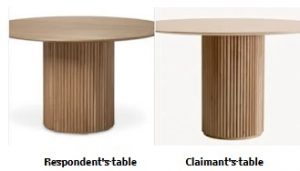

The defendant, Mio, firmly rejected the aforementioned allegations. Mio’s arguments centered on three main points: First, Mio contended that the “Palais Royal” table failed to meet the threshold of “originality” required to qualify as a copyright-protected work, because its design is composed of basic geometric shapes and elements considered commonplace in the furniture sector. Second, Mio argued that, even assuming the “Palais Royal” table qualified for protection, the scope of protection for such a work of applied art must be narrowly construed; therefore, the detailed differences between the two tables are sufficient to preclude infringement. Third, Mio asserted that the “Cord” table was the result of an independent design process, rather than a copy of Asplund’s design.
The Swedish court of first instance ruled in favor of the plaintiff, Asplund, in its judgment dated October 19, 2022, finding that Mio had committed copyright infringement and issuing an injunction to bar Mio from continuing to market the infringing product. Disagreeing with this judgment, Mio filed an appeal with the Svea Court of Appeal (Svea hovrätt, Patent- och marknadsöverdomstolen).
At the appellate level, the Court acknowledged the difficulties and complexities involved in applying copyright law to works of applied art. The Court was confronted with several pivotal legal questions, including whether the assessment of a work’s originality should be based on the creative process (the author’s intent and choices during the design phase) or determined primarily by the physical form of expression visible on the product. Furthermore, when evaluating infringement, could the Court apply the “overall impression” criterion – a familiar standard in industrial design law – or must it focus on comparing and identifying the reproduction of specific protected creative elements?
Faced with these fundamental issues of principle, whose significance extends far beyond the scope of this specific case and warrants a uniform interpretation at the continental level, the Svea Court of Appeal decided to stay the proceedings and submit a request for a preliminary ruling to the Court of Justice of the European Union (CJEU) under Case C-580/23, requesting the CJEU to clarify the criteria for determining originality and infringement regarding works of applied art under Directive 2001/29/EC (the InfoSoc Directive).
2. The Advocate General’s Analysis: The Separation Between Industrial Design and Copyright
In his Opinion delivered on May 8, 2025, concerning the joined cases C-580/23 (Mio) and C-795/23 (konektra), Advocate General (AG) Szpunar did not merely address technical questions; he conducted a systematic analysis to clarify the boundaries between two protection mechanisms that are frequently conflated: industrial design law and copyright law.
Advocate General Szpunar’s position can be summarized into three core arguments, which reject the “conventional” approaches that many national courts – including those in Sweden and Germany – still struggle to apply in disputes concerning works of applied art.
2.1. No “General Rule – Exception” Relationship: Equal Treatment of Protection Standards
An argument frequently invoked by defendants (as seen in both the Mio and konektra cases) is that because the subject matter of the dispute involves products of applied art (such as tables, chairs, or furniture), the threshold for obtaining copyright protection must be more stringent, or alternatively, copyright should only be viewed as an exceptional mechanism compared to industrial design protection.
Advocate General Szpunar completely rejects this view. Drawing upon the principles established in the Cofemel precedent, he affirms that the two protection systems operate independently and pursue distinct objectives:
- Industrial design law protects the appearance of a product based on novelty and individual character.
- Copyright law protects intellectual creation based on originality.
Consequently, Advocate General Szpunar concludes that there is no “higher threshold” whatsoever for works of applied art. If a dining table reflects the “author’s own intellectual creation”, it is entitled to the exact same copyright protection as a poem, a musical composition, or a painting. No discrimination should exist between “pure” works of art and products that incorporate functional elements.
2.2. Originality: “Free Creative Choice” Outweighs “Subjective Intent”
One of the most complex legal issues in the Asplund case is how to determine the originality of a design that is significantly influenced by functional requirements – for example, the tabletop must be flat and the structure sufficiently stable to bear weight.
Advocate General Szpunar provides two key guiding principles:
- Free and creative choices: This is the central criterion. The court must identify the points where the designer possessed genuine creative freedom – meaning areas where they could make decisions regarding the form without being constrained by technical requirements.
- If a curve is created solely to increase load-bearing capacity → that is a technical solution, falling outside the scope of copyright protection.
- Conversely, if the curve was selected for aesthetic reasons while multiple alternative technical options were available → that constitutes a creative choice, reflecting the personal touch of the author.
- Objective expression outweighs subjective intent: Advocate General Szpunar affirms that courts must not base their assessment on the author’s self-declared explanations or artistic intentions. A creative intent carries legal weight only when it is objectively manifested in the actual form of the product. Therefore, originality must be identified directly from the visual expression of the design, rather than from the desires or declarations of the designer.
2.3. Infringement Criteria: The End of the “Overall Impression” Doctrine in Copyright Law
This is the most critical and defining highlight in Advocate General Szpunar’s Opinion. In the field of Industrial design, infringement is determined based on whether the contested product produces a “different overall impression” compared to the registered design. In practice, this approach occasionally facilitates acts of imitation: a copyist can evade a finding of infringement simply by altering a few minor details to create a sense of “difference.”
However, Advocate General Szpunar firmly asserts that the “overall impression” standard is entirely inapplicable to the field of copyright law. Copyright protects specific creative elements rather than the overall appearance of the product from a generalized perspective. Consequently, the infringement assessment process must adhere to two fundamental steps:
- Identify the protected creative elements within the original product – namely, the specific details that manifest the author’s “free and creative choices” (for instance, the layout and visual treatment of the wooden slats forming the base of the Palais Royal table).
- Cross-reference these with the accused product to determine whether these creative elements have been recognizably copied.
If the answer is yes, then infringement is established – irrespective of whether the two products, when viewed as a whole, produce a similar or different impression.
Advocate General Szpunar clearly emphasizes: “The fact that two objects produce the same overall impression is not sufficient to conclude infringement; conversely, producing a different overall impression is not sufficient to preclude infringement if the core creative elements have been copied.”
This statement marks a significant step in reorienting the approach of national courts when resolving applied art disputes within the framework of copyright law.
3. The Legal Balance: Which Side is the Advocate General’s Opinion Tipping Toward?
From the detailed analysis of Advocate General Szpunar, it is evident that the legal assessment is tilting heavily in favor of Asplund (the Plaintiff) and places a significant disadvantage on Mio’s defense arguments. Specifically:
(i) Neutralizing the defense strategy based on the “overall impression” relied upon by the Defendant, Mio: Mio’s arguments – and even the approach reflected in the preliminary questions submitted by the Swedish Court to the CJEU – demonstrate a reliance on the framework of Industrial Design Law. Mio might argue that: “The Cord table, when viewed as a whole, possesses certain distinct differences. Asplund’s design merely consists of simple geometric shapes, thus exhibiting a low level of creativity.”
However, Advocate General Szpunar has completely rejected this approach based on two core principles:
- Do not evaluate “high or low levels of originality”; and
- Do not apply the “overall impression” standard in copyright law.
Consequently, if the elements reflecting creative choices – such as Asplund’s signature layout of the wooden slats – are proven to have been reproduced by Mio, then infringement is established, regardless of any overall differences.
(ii) Easing the burden of proof for Asplund: In the view of Advocate General Szpunar, Asplund does not need to prove that its design reaches a level of “exceptional artistry” or possesses superior creativity. They only need to demonstrate that:
- At certain locations of the design (such as the table base structure), the designer possessed the freedom to choose from multiple alternatives; and
- The chosen alternative embodied in the Palais Royal model is the result of a creative decision bearing the author’s personal touch;
- Mio nevertheless reused those exact creative elements.
Under this approach, the burden of proof regarding originality becomes more practical and far easier for the plaintiff to satisfy.
(iii) Tightening the conditions for Mio to employ the “independent creation” defense: Mio contends that the Cord design is the result of an independent creative process. Advocate General Szpunar acknowledges that coincidental similarities can occur, particularly in the field of highly functional products. However, he emphasizes:
- The mere theoretical possibility of independent creation is insufficient;
- If there are indications that Asplund’s recognizable creative elements have been replicated, the “independent creation” defense will lack a solid foundation; and
- Mio will be required to produce clear, consistent, and verifiable R&D evidence, rather than relying on mere verbal assertions.
This raises Mio’s defensive barrier significantly, making it far more difficult to overcome.
In conclusion, Advocate General Szpunar’s Opinion delivers a positive signal for copyright owners such as Asplund. This approach effectively dismantles the “defense mechanism” based on the “overall impression” standard, which is frequently invoked by copyists to evade legal liability. If the Court of Justice of the European Union (CJEU) adopts this view in its final judgment, copycat businesses will face substantial legal risks, as modifying a few minor details simply to create a different “general impression” will no longer suffice to preclude copyright infringement liability.
Conclusion
For businesses in the furniture and handicraft industries—where the boundaries between artistic creation and industrial production constantly intersect – the dispute between Asplund and Mio, alongside Advocate General Szpunar’s Opinion, delivers a dual message: serving as both a wake-up call and a guide for action.
The wake-up call lies in the fact that the “defense mechanism” based on the argument of a “distinct overall impression”, long relied upon by copyists, is now at risk of being dismantled in copyright disputes. Businesses can no longer operate under the outdated mindset that merely altering a few minor details to make the overall design look “slightly different” is enough to escape infringement claims. If your product replicates the specific “creative choices” of a competitor (such as the structure of the wooden slats or the treatment of the joints), the legal risk is real and severe – regardless of whether the two products might look different at a glance.
The opportunity lies in the fact that the Advocate General’s Opinion clarifies the path to self-protection: namely, “independent creation”. To avoid allegations of copying, businesses must proactively build a transparent design history file – proving that any similarities are the result of coincidental overlap due to functional constraints or market trends, rather than the copying of elements bearing someone else’s “personal touch.”
Simultaneously, this case provides a crucial framework of reference for judicial practice in Vietnam. In the context where Vietnamese Intellectual Property Law is progressively refining its protection mechanisms for works of applied art, the clear distinction between the “overall impression” standard of Industrial Design Law and the “reproduction of specific creative elements” standard of Copyright Law – as currently shaped by the European legal system – can assist domestic courts and enforcement authorities in avoiding confusion regarding evaluation standards. This will contribute to fostering a healthier competitive environment, leaving significantly less room for the practice of “modifying to simulate” the designs of others to persist.
With 15 years of operations and experience handling hundreds of intellectual property disputes and infringement cases, KENFOX IP & Law Office possesses a profound understanding of the legal challenges surrounding the protection and enforcement of rights in applied designs. We do not merely assist businesses in establishing and registering Industrial Design and Copyrights; we formulate specialized advisory and litigation strategies focused on identifying and proving “core creative elements” – the key factor in effectively safeguarding design assets and maximizing the probability of success in complex infringement disputes.
QUAN, Nguyen Vu | Partner, IP Attorney
NGA, Đao Thi Thuy | Senior Patent Attorney
Kim Anh, Nguyen Thi | Patent Executive
Related Articles:
- Industrial Design Or Copyright Protection, Which You May Be Unaware Of?
- Copyright – a powerful and effective weapon to repress trademark and industrial design infringements in Vietnam
- Brompton – When a Folding Bicycle Becomes a “Work” – The Judgment of the Court of Justice of the European Union
- 6 key takeaways to cope with patent infringement allegations in Vietnam
- Industrial design protection for products under the Hague System – Key to business success in Vietnam
- Vietnam’s Amended IP Law Of 2022: How 12 Critical Patent Provisions Affect You
- Functional Products: Industrial Design Protection or Copyright Protection in Vietnam?
- To register or to lose, a costly lesson from a typical industrial design dispute in Vietnam
- Whether Functional Products Are Eligible for Protection as ‘Works of Applied Art’ in Vietnam?