






USM v. Konektra: Does a Functional Product Require a Higher Degree of Creativity to Merit Copyright Protection?
Conventional legal thinking often takes for granted that “technical product systems”—such as modular furniture sets, replacement parts, or industrial machinery—fall primarily within the regulatory scope of Design Law or Patent Law. Right holders rarely have the fortitude to opt for the copyright mechanism, largely due to a deeply ingrained perception: for applied products, in order to prevent “overlap” with design law, the law must establish a higher, more stringent “creativity threshold” compared to purely literary and artistic works.
Against this backdrop, KENFOX IP & Law Office will analyze the case of 1. USM v. Konektra – Liệu sản phẩm mang tính công năng có cần mức độ sáng tạo cao hơn để được bảo hộ bản quyền.docx (referenced verbatim) to elucidate how the Court of Justice of the European Union (CJEU) and Advocate General Szpunar are progressively reshaping the legal framework governing technical products. This case is not merely a dispute between a renowned Swiss furniture conglomerate and a German manufacturer of replacement parts regarding the famous USM Haller shelving system; it also poses a fundamental legal question:
- Does a “rule-exception” relationship exist between design law and copyright law?
- Must a heavily functional design satisfy a stricter standard to be recognized as a “work” within the meaning of copyright?
Answering these questions will enable enterprises to better grasp the new standards of protection for industrial product lines, thereby formulating effective protection strategies against competitors producing “compatible” or simulated goods.
1. Factual Background
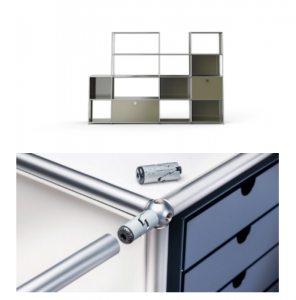
USM U. Schärer Söhne AG (USM) is a prestigious Swiss furniture company widely recognized globally for its modular furniture system named “USM Haller”. Launched in 1965, this system has become an icon of modern design, identifiable by its frame structure comprising polished chrome-plated steel tubes interconnected by characteristic spherical joints (ball joints), forming a supporting framework for colored metal panels. The defining feature of USM Haller lies in its high modularity and customizability: users can flexibly assemble and expand the system both vertically and horizontally to meet diverse spatial and functional needs.
Konektra GmbH (Konektra) is a Germany-based company operating in the business of furniture products and accessories. Initially, Konektra supplied replacement parts (spare parts) compatible with the USM Haller system, matching the shape and color of the original products, an activity that did not meet with opposition from USM.
However, the dispute erupted when Konektra’s business operations exceeded the scope of supplying ordinary repair parts. Since 2018, on its e-commerce website, Konektra has not only sold individual, standalone components and accessories but has also begun listing and offering for sale complete sets of components necessary to assemble finished furniture units (shelving furniture) structurally similar to the USM Haller system. Concurrently, Konektra utilized images of fully assembled furniture products for promotional purposes, provided detailed assembly instructions, and even offered turnkey installation services to customers.

Example: USM Haller shelving furniture. Source: USM Haller website
USM initiated legal proceedings against Konektra before the Düsseldorf Regional Court (Landgericht Düsseldorf). USM argued that Konektra was no longer merely selling spare parts, but was in fact manufacturing and commercializing an identical furniture system, thereby infringing the copyright in the work of applied art “USM Haller”. Konektra countered that the USM Haller system is a technical and functional product, and consequently fails to satisfy the standard of originality required for copyright protection.
The court of first instance (Landgericht Düsseldorf) accepted USM’s arguments and recognized copyright protection. However, at the appellate level, the Düsseldorf Higher Regional Court (Oberlandesgericht Düsseldorf) reversed this judgment on June 2, 2022. The Court of Appeal dismissed USM’s claim for copyright protection (upholding only the claims based on unfair competition law), on the grounds that the design had not attained the requisite level of creativity.
The case was subsequently appealed to the German Federal Court of Justice (Bundesgerichtshof). Here, the German supreme court found itself in a legal dilemma. Under traditional German jurisprudence (prior to the Cofemel precedent), for a work of applied art to be protected by copyright, it had to surpass a higher “creativity threshold” than purely artistic works, aimed at avoiding overlap with Registered Design protection (the Stufentheorie doctrine). However, recent judgments of the Court of Justice of the European Union (CJEU) appeared to reject this discriminatory treatment.
Faced with this ambiguity, the German Federal Court of Justice decided to stay the proceedings and refer questions for a preliminary ruling to the CJEU in Case C-795/23, requesting clarification on a core issue: Does EU law recognize a “Rule-Exception” relationship between Design protection and Copyright protection? In other words, the German Court sought to know whether they are permitted to apply a stricter standard of originality to functional designs like USM Haller, or whether they are compelled to lower the standard to be on par with other literary and artistic works.
2. Analysis of the Advocate General: Reshaping the Standard for “Works of Applied Art”
The legal opinion regarding Case C-795/23 (USM v. Konektra) delivered by Advocate General Szpunar marks an important refinement of the EU approach to copyright protection for works of applied art. He presented a rigorous and definitive argument, thereby completely rejecting the application of a “double standard” to works of applied art, which had been causing confusion for German courts. His analysis does not merely resolve the specific dispute concerning the USM Haller shelving system, but also contributes to reaffirming the fundamental boundary between “copyright” and “design”—while clarifying two pivotal criteria: originality and the determination of infringement.
2.1. No Hierarchy: Copyright and Industrial Designs are Two Independent Mechanisms
The central question posed by the German Federal Court of Justice was: Does EU law establish a “rule-exception” relationship between the design protection mechanism and the copyright protection mechanism? Under the traditional German approach (Stufentheorie), design protection is deemed the general rule for industrial products, whereas copyright is viewed merely as a narrow exception, reserved exclusively for products that clear an above-average “creativity threshold”.
Advocate General Szpunar decisively rejected this view. He affirmed that, within the framework of EU law, there exists no hierarchy or relationship of dependence between the two aforementioned protection systems. The fact that an object (such as the USM Haller cabinet system) has already enjoyed protection under design law neither precludes nor increases the conditions for that object to simultaneously be protected under the copyright mechanism. Advocate General Szpunar emphasized that: when assessing the originality of a work of applied art, it is impermissible to apply a stricter standard than that applied to other categories of works (such as literary, musical, or pure fine art works).
The legal consequence of this argument is clear: a set of tables and chairs or a shelving system does not need to prove that it attains the level of “high art” or possesses “exceptional artistic quality” to be eligible for copyright protection; it merely needs to satisfy the same threshold of “originality” as any other category of work.
2.2. Clarifying the Confusion: “Subjective” and “Objective” Standards
To explain why the two protection mechanisms cannot be conflated, Advocate General Szpunar pointed out the intrinsic difference between them—which is precisely the point where enterprises and even Courts frequently confuse:
- Design Law operates on the foundation of an “objective” criterion: To be protected, a design must satisfy “novelty” and “individual character”. The assessment is conducted by comparing that design with the corpus of designs previously made available to the public on the market. This mechanism does not focus on the “creative persona” of the designer, but rather on whether the design produces a novel, distinct overall impression on the informed user.
- Copyright Law is based on a “subjective-personal” criterion: To be deemed a “work”, the object must possess “originality”, which is understood as the expression of the author’s personal touch through creative choices made freely, without being completely dictated by technical constraints or mandatory conventions.
Accordingly, with respect to the USM Haller system, the legal question is not: “Is this design novel and individual compared to pre-existing shelving systems?”—which falls within the scope of review of Design law.
Rather, it must be: “In the process of formatting the shape of the shelving system, did Paul Schärer and Fritz Haller make choices regarding lines, proportions, structure, and layout… on the basis of free creativity and personal aesthetic preference, or is the external appearance of the product merely the inevitable result of technical requirements?”
This clarity in phrasing effectively segregates the two tiers of evaluation: one focused on an objective contrast with the established design ecosystem, and the other tracing the author’s subjective creative stamp within the architectural structure itself.
2.3. Understanding the Cofemel Precedent: Cumulative Protection is Not an ‘Exceptional Case’
Previously, in the Cofemel judgment, the Court of Justice of the European Union (CJEU) observed that the cumulative protection of an object under both mechanisms—design and copyright—can only occur “in certain cases”. This phrasing led the German Federal Court of Justice to understand that the CJEU intended to restrict the scope of application of copyright to industrial designs.
In the present Opinion, Advocate General Szpunar directly clarified and adjusted that interpretation. He explained that the phrase “in certain cases” does not imply that cumulative protection is rare, anomalous, or subject to a stricter standard, but merely reflects a conditional principle:
- Only objects that fully satisfy the criterion of “originality”—meaning they manifest the author’s personal touch through free and creative choices—are eligible for copyright protection.
- Conversely, if the form of the product is merely the inevitable result of technical constraints, functional standards, or technological solutions, leaving no room for the expression of creative personality, then it naturally cannot benefit from the copyright protection mechanism.
Thus, instead of establishing “a higher tier of protection” for industrial design, the Cofemel precedent—under the lens re-interpreted by Advocate General Szpunar—merely reaffirms the fundamental principle of copyright law: protection is reserved exclusively for that which genuinely bears the author’s personal creative touch, regardless of whether it is a pure work of art or an industrially applied product. There is no requirement for a “higher threshold” regarding works of applied art.
2.4. Originality: “Free and Creative Choices” as the Core of Assessment
One of the pivotal questions referred by the national courts to the CJEU is: When can a functional design be considered “original” so as to merit copyright protection? This is not merely a technical question, but touches upon the core philosophy of originality—what truly makes a design form “belong” to its author.
Advocate General Szpunar commenced by emphasizing that the assessment of originality cannot be detached from the nature of the category of work under consideration. For works of applied art, which are constrained by function, functional standards do not allow courts to automatically presume creativity as they would for purely artistic works. Here, the court must “distill” which elements are dictated by function and which constitute the author’s creative touch.
An important point clarified by Advocate General Szpunar concerns terminology. He cautioned that using terms such as “artistic” or “aesthetic” to describe the author’s choices can easily lead to misinterpretation—these words sometimes imply creativity, but not invariably so. To avoid this ambiguity, the AG recommended utilizing a more precise phrase:
“free and creative choices reflecting the author’s personal touch”
This recommendation aligns with the proposal of the European Copyright Society, aimed at ensuring that the Court’s wording remains consistent and comprehensible when translated into all EU languages.
Regarding the issue of the author’s subjective creative intent, Advocate General Szpunar set forth a highly important standard: the Court can only consider this intent if it is objectively manifested in the work. If an author declares an intention to create a “work of art,” but the form of expression does not reflect a personal touch, that declaration carries no legal weight.
The AG reiterated the principle established by the CJEU: “For a work to be deemed original, it is necessary and sufficient that the work reflects the author’s personal touch through their free and creative choices.” In other words, the court does not assess the author’s “state of mind” or “artistic intent,” but rather evaluates what has actually been expressed in the work.
Drawing upon the Brompton precedent, Advocate General Szpunar acknowledged that courts may consider all factors presented by national courts—such as the author’s utilization of common shapes, design trends in the industry, or recognition by experts—but only as contextual reference points, and such factors must not obscure the central criterion: whether the work reflects free creative choices.
This leads to two important legal consequences:
- A work utilizing familiar shapes can still be original if the manner of combination reflects personal choice.
- Two functional designs may look similar, or even identical, due to functional constraints—yet remain legally original if they were created independently.
Finally, Advocate General Szpunar addressed a frequently cited factor: the display of the work in museums or its recognition by design experts. This may constitute a corroborating factor, but he emphasized that it is never a necessary or sufficient condition. Such recognition must stem from creative value, rather than from the technical novelty or functional efficiency of the design.
In short, AG Szpunar clearly recalibrated the standard: originality does not reside in how aesthetically pleasing, novel, or complex a design appears, but rather in whether that form of expression is genuinely the result of free formative choices bearing the imprint of the author themselves.
2.5. Determining Infringement: No More “Overall Impression”, Only the Copied Creative Touch
In addition to the question of originality, an equally significant issue referred by the Swedish and German courts to the CJEU is: What criteria should be applied to assess copyright infringement in a work of applied art?
This point marks a turning point in the application of the law, because for many years, enterprises manufacturing compatible or copycat products frequently relied on the argument of “altering a few minor details to create a distinct overall impression” to evade liability.
Advocate General Szpunar affirmed that: the “overall impression” standard does not belong to the realm of copyright law at all. The Advocate General emphasized that copyright and design law are two legal systems operating under completely different logics, and this distinction must be maintained both at the stage of establishing protection and that of determining infringement. If the “global impression” standard continues to be utilized in copyright, the boundary between the two protection mechanisms will be obliterated—an error that must be rectified.
On that basis, Advocate General Szpunar reaffirmed the criterion for copyright infringement: An act is deemed infringing when the elements expressing “free and creative choices reflecting the author’s personal touch” are reproduced in an identifiable manner.
This is precisely the principle established in the Infopaq precedent and further developed by Advocate General Szpunar based on the reasoning in Pelham: even a small part, provided that part is creative, and that creative part is reproduced in a manner discernible to an observer, is sufficient to constitute infringement.
Importantly, the Court is not permitted to rely on the “overall impression”. Not only is it insufficient, but Advocate General Szpunar asserted that courts must not invoke or apply this criterion in a copyright analysis, putting an end to the long-standing practice of conflating the two assessments.
Advocate General Szpunar proceeded to provide specific guidance for national courts:
(i) The degree of originality does not affect the scope of protection: Advocate General Szpunar noted that the “height of creativity” is not a basis for narrowing or expanding the scope of protection. A work possessing a “moderate” degree of creativity is still fully protected—provided it clears the legal threshold of originality. This directly refutes the German position that applied works require a “higher threshold”.
(ii) If the creative structure is copied, infringement is established: When a work utilizes commonplace formal elements, creativity resides in the arrangement, coordination, and selection—the combination of those elements. Therefore, if the creative arrangement is reproduced, infringement is constituted, even if each individual component consists of familiar shapes. Conversely, merely copying general elements without reproducing the creative structure does not suffice to constitute infringement.
(iii) Following the same style or design trend does not generate infringement: A second author may be inspired by a general visual trend in the industry (e.g., Bauhaus style, Scandinavian minimalism…), but it is only when specific creative elements of the original work are copied that it will be deemed infringing. This safeguards creative freedom and the development of a common design language.
(iv) The principle of independent creation: Advocate General Szpunar reiterated a foundational principle of copyright law: If two works are identical but were created independently without copying, no infringement occurs. This is an important bulwark protecting genuine creativity in a context where applied products are frequently limited by function and technical standards—causing many designs to look naturally similar.
From now on, the focus of the legal question is reduced to a single inquiry: “Are the creative choices bearing the personal touch of the original author reproduced in the allegedly infringing product?” This is the most crucial shift brought about by AG Szpunar: eradicating the protracted confusion between design law and copyright law, and returning copyright to its true essence—the protection of human personal creativity.
2.6. Preliminary Assessment: The Balance of Arguments Tilts in Favor of USM
Although Advocate General Szpunar did not explicitly affirm USM as the prevailing party (as the jurisdiction to assess facts and apply specific law rests with the German Court), his line of reasoning in practice significantly strengthens USM’s legal standing and places a distinct disadvantage on Konektra’s defense.
Konektra relied on the proposition that the USM Haller system is essentially a technical system, and therefore copyright protection for this design must be subject to a stricter standard, and could thereby be excluded. However, with the Advocate General completely rejecting the notion of a “stricter standard” for applied products, the hurdle for USM Haller to be recognized as a “work” within the meaning of copyright law is brought to the same level as other categories of works.
In this context, USM’s task is “reduced” to proving that: the selection of the chrome-plated steel tube structure and spherical joints was not entirely the inevitable result of technical requirements, but rather left room for aesthetic choices and free formation by the designer. This is a far more practical and feasible burden of proof than forcing USM to demonstrate that the USM Haller system is an extraordinary “artistic masterpiece” to be eligible for the copyright protection mechanism.
Conclusion
For enterprises in the fields of industrial manufacturing and modular furniture, the dispute between USM and Konektra, along with the Opinion of Advocate General Szpunar, marks a turning point in intellectual property protection strategy, delivering a dual message: the expansion of authority for creators and a wake-up call for ancillary business models.
The warning lies in the fact that business models predicated on manufacturing “replacement parts” or “compatible goods” are no longer the absolute legal safe harbors they once were. Enterprises can no longer merely rely on the argument that the original product is “technical” or “functional” to evade allegations of copyright infringement. If a technical system—whether a shelving unit, machinery, or equipment—contains formal choices bearing the author’s “personal touch,” commercializing reproductions of those parts can lead to severe legal repercussions, even if the original product’s design patent or registration expired long ago.
The opportunity resides in the reality that this ruling (if adopted) will grant Original Equipment Manufacturers (OEMs) a long-term shield. Copyright, with a duration of protection spanning the author’s life plus 70 years, will become a potent tool to “extend the lifespan” of classic designs, enabling enterprises to maintain an exclusive advantage far beyond the maximum 15-to-25-year limit of Industrial Designs. This incentivizes Vietnamese enterprises to invest seriously in Research and Development (R&D) and design, because each original creation possesses the potential to become an intangible asset of commercial value exploitable across generations.
The case of USM v. Konektra also provides an important reference framework for legal practice in Vietnam, where intellectual property disputes concerning works of applied art are on the rise. Eliminating the “double standard” mindset (the notion that if an item is protected under “industrial design,” it cannot be protected under “copyright”)—and avoiding discrimination between pure art works and industrial designs—will render the business environment more transparent and equitable for genuine creative efforts.
As one of the leading Intellectual Property consulting firms, KENFOX IP & Law Office constantly updates the latest legal developments from key jurisdictions like the EU to provide optimal solutions for our clients. We do not merely assist enterprises in registering Design protection, but also advise on strategic portfolio building to establish “work” status for industrial products, helping you set up a comprehensive, robust protection mechanism against all acts of infringement and unfair competition.
By Nguyễn Vũ Quân | Partner, IP Attorney
Đào Thị Thúy Nga| Senior Patent Attorney
Nguyễn Thị Kim Anh| Patent Executive
Related Articles:
- Cofemel v. G-Star: The new standard of the European Court of Justice – Can a pair of jeans be considered a “work of art”?
- New product launch: How to keep your product design from being “stolen”?
- Industrial Design Related Matters in Vietnam
- Industrial design protection for products under the Hague System – Key to business success in Vietnam
- To register or to lose, a costly lesson from a typical industrial design dispute in Vietnam
- Provisional rights to patents and industrial designs in Vietnam – What you need to know?
- Industrial Design Or Copyright Protection, Which You May Be Unaware Of?
- What are Key Considerations for Industrial Design Divisional Application in Vietnam?
- Copyright – a powerful and effective weapon to repress trademark and industrial design infringements in Vietnam
- 10 Key Points from Vietnam’s New IP Decree No. 65/2023/ND-CP
- Handling intellectual property rights infringement in Vietnam: Which measures are effective?
- Difference between Copyright and Industrial Design Right
- Amendments to patent and industrial design regulations under the draft of the amended Intellectual Property Law