KENFOX IP & Law Office > Articles posted by Quoc Anh

Brompton – When a Folding Bicycle Becomes a “Work” – The Judgment of the Court of Justice of the European Union

Download Can a functional product—created to satisfy everyday practical needs—be regarded as an artistic “work” eligible for copyright protection? In the conventional thinking of many businesses and even legal practitioners, the answer is almost automatically “no”. Bicycles are associated with patents, clothing and footwear belong to the realm of industrial designs, while sandals and handbags are merely consumer goods. However, the judgment of the Court of Justice of the European Union (“CJEU”) in Brompton Bicycle v. Chedech/Get2Get (Case C-833/18) introduced a new perspective: a functional shape may be viewed not merely as a technical solution, but also as the creative expression...

Continue reading

USM v. Konektra: Does a Functional Product Require a Higher Degree of Creativity to Merit Copyright Protection?

Download Conventional legal thinking often takes for granted that “technical product systems”—such as modular furniture sets, replacement parts, or industrial machinery—fall primarily within the regulatory scope of Design Law or Patent Law. Right holders rarely have the fortitude to opt for the copyright mechanism, largely due to a deeply ingrained perception: for applied products, in order to prevent "overlap" with design law, the law must establish a higher, more stringent "creativity threshold" compared to purely literary and artistic works. Against this backdrop, KENFOX IP & Law Office will analyze the case of 1. USM v. Konektra - Liệu sản phẩm mang tính...

Continue reading

Cofemel v. G-Star: The new standard of the European Court of Justice – Can a pair of jeans be considered a “work of art”?

Download

Conventional legal thinking often defaults to the premise that “functional products”—such as a pair of jeans, a pair of sandals, a fashion handbag, or a perfume bottle—fall primarily within the scope of Industrial Design protection. Rights holders rarely consider the mechanism of Copyright, due to the misconception that the form of mass-produced products can hardly meet the threshold of a “work” or a “work of applied art” to warrant protection.

KENFOX IP & Law Office will analyze the case of Cofemel v. G-Star to elucidate how the Court of Justice of the European Union (CJEU) established a new standard in viewing applied designs from a Copyright perspective. The case not only poses the question of whether a pair of jeans—traditionally viewed as a common consumer product—can be recognized as a “work,” but also opens up a broader debate regarding the boundary between utility and creativity. From this, businesses can conceptualize the prerequisites that must be satisfied to determine when a “functional product” can still be protected under copyright law, alongside the industrial design protection mechanism.

1. Background of the incident

G-Star Raw (G-Star Raw CV) is a renowned Dutch fashion company, founded in 1989 in Amsterdam. The brand is globally famous for its denim products (jeans) and its raw, rugged design style. Cofemel (Cofemel – Sociedade de Vestuário SA) is a Portuguese fashion company. It owns the fashion brand Tiffosi, which is highly popular in Portugal and Spain, specializing in the manufacture and trade of ready-to-wear apparel.

In 2013, G-Star Raw initiated legal proceedings against Cofemel, alleging that Cofemel had copied its jeans and t-shirt models named “ARC” and “ROWDY”. The Plaintiff, G-Star, argued that the “ARC” and “ROWDY” models were not merely everyday apparel, but rather the culmination of an intentional, original creative process, thereby qualifying them as “works” eligible for protection under copyright law. Conversely, the Defendant, Cofemel, countered that clothing serves a functional purpose, and such apparel designs cannot be classified as “works” entitled to such protection. Additionally, Cofemel argued that to be eligible for copyright protection, a design must transcend into “art” and possess a specific “aesthetic value” or “artistic effect”.

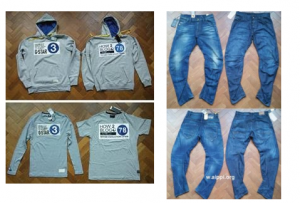
Image source : www.alamy.com/ www.sgcr.pt and www.aippi.org

The Portuguese Court of First Instance ruled in favor of G-Star, recognizing the ARC and ROWDY models as “works,” ordering Cofemel to cease its infringing acts, and directing the disgorgement of profits. Cofemel appealed the judgment to the Tribunal da Relação de Lisboa (Court of Appeal, Lisbon, Portugal), which subsequently affirmed the lower court’s decision.

The case was further appealed to the Supreme Court of Portugal. This apex court acknowledged that G-Star’s designs were the result of a creative design process featuring specific formative elements, and that Cofemel had incorporated several of those elements into its own products. However, the Supreme Court faced a legal dilemma: the Portuguese Copyright Act did not explicitly define the requisite threshold of “originality” for this category of designs, and judicial practice reflected the view that an “aesthetic effect” or “high artistic value” was required to trigger protection.

Consequently, the Supreme Court of Portugal referred a question to the Court of Justice of the European Union (CJEU) for a preliminary ruling in Case C-683/17, seeking clarification on whether Article 2(a) of Directive 2001/29/EC (the InfoSoc Directive) permits a Member State to reserve copyright protection for designs that produce a “specific aesthetic effect,” in addition to the criterion of “originality”.

Trademarks or Disguised Advertising Messages: CNIPA’s Proactive Invalidation of Granted Trademarks – Could Vietnam Adopt a Similar Approach?

Download The Situation in China: A Drastic Purge of "Pseudo-Concepts" In recent times, the China National Intellectual Property Administration (CNIPA) has sent shockwaves through the legal and business communities by consistently implementing measures to refuse and proactively invalidate a series of trademarks that are ambiguous, deceptive,, or likely to mislead consumer perception. The review process reveals that numerous applications were summarily rejected during the substantive examination stage, most notably: 18 "Zero Sucrose" trademarks, 22 "0 Sucrose" trademarks, and others such as "Earth from the Mountains" and "0 Added West." Notably, since 2025, CNIPA has expanded its oversight beyond the examination stage to proactively...

Continue reading

China: CNIPA Proactively Refused and Invalidated Ambiguous-Concept Trademarks Such as “Zero Sucrose” and “Farm-Raised”

Download Many enterprises do not design trademarks to distinguish their goods from those of others - the core function of a trademark. Instead, they exploit the system to "privatize" common industry terminology. They treat the trademark registration certificate as a "legal free pass" to monopolize advertising messages (such as "Zero Sugar" or "Farm-Raised"). Armed with these registered marks, they can then turn around and restrict competitors from using descriptive terms that everyone should inherently have the right to use. Cloaking vague and exaggerated descriptive terms under the guise of an "exclusively registered trademark" creates a false veneer of credibility. Consumers are easily...

Continue reading

Opposition Against the Trademark “7 DAYZ” / “7 DAYS PREMIUM MENWEAR & Device”: 5 Lessons in Trademark Protection in Vietnam

Download In intellectual property portfolio management, challenging a subsequent trademark application that "borrows" ideas while being disguised by stylized details remains a complex issue. Therefore, protecting brand identity extends beyond mere name registration; it is a strategic battle to safeguard the "zone of recognition" within the minds of consumers. In this context, the successful prevention of trademark application No. 4-2023-36026 demonstrates a crucial principle: an effective opposition dossier must be built upon a strict integration of legal analysis regarding the similarity of the signs and designated goods/services, alongside a practical assessment of how the brand is perceived, recalled, and competes in...

Continue reading

Why Patents “Lose Rights” Upon Entering the Vietnam National Phase: Translation Errors, “New Matter”, and Limitations on Amendments

Download In patent prosecution practice, many applications "fail" - not because the technical solution lacks novelty or an inventive step, but due to the Vietnamese translation at the national phase entry. For patent applications originating from the Patent Cooperation Treaty (PCT) or those claiming priority under the Paris Convention upon entering the national phase in Vietnam, merely a few mistranslated words in the specification or, particularly, the claims, can inadvertently and silently narrow the scope of protection. By the time this is discovered, it is often too late to remedy. The greatest risk lies in the fact that the Vietnamese translation serves...

Continue reading