Brompton – When a Folding Bicycle Becomes a “Work” – The Judgment of the Court of Justice of the European Union

Download Can a functional product—created to satisfy everyday practical needs—be regarded as an artistic “work” eligible for copyright protection? In the conventional thinking of many businesses and even legal practitioners, the answer is almost automatically “no”. Bicycles are associated with patents, clothing and footwear belong to the realm of industrial designs, while sandals and handbags are merely consumer goods. However, the judgment of the Court of Justice of the European Union (“CJEU”) in Brompton Bicycle v. Chedech/Get2Get (Case C-833/18) introduced a new perspective: a functional shape may be viewed not merely as a technical solution, but also as the creative expression...

Continue reading

USM v. Konektra: Does a Functional Product Require a Higher Degree of Creativity to Merit Copyright Protection?

Download Conventional legal thinking often takes for granted that “technical product systems”—such as modular furniture sets, replacement parts, or industrial machinery—fall primarily within the regulatory scope of Design Law or Patent Law. Right holders rarely have the fortitude to opt for the copyright mechanism, largely due to a deeply ingrained perception: for applied products, in order to prevent "overlap" with design law, the law must establish a higher, more stringent "creativity threshold" compared to purely literary and artistic works. Against this backdrop, KENFOX IP & Law Office will analyze the case of 1. USM v. Konektra - Liệu sản phẩm mang tính...

Continue reading

Cofemel v. G-Star: The new standard of the European Court of Justice – Can a pair of jeans be considered a “work of art”?

Download

Conventional legal thinking often defaults to the premise that “functional products”—such as a pair of jeans, a pair of sandals, a fashion handbag, or a perfume bottle—fall primarily within the scope of Industrial Design protection. Rights holders rarely consider the mechanism of Copyright, due to the misconception that the form of mass-produced products can hardly meet the threshold of a “work” or a “work of applied art” to warrant protection.

KENFOX IP & Law Office will analyze the case of Cofemel v. G-Star to elucidate how the Court of Justice of the European Union (CJEU) established a new standard in viewing applied designs from a Copyright perspective. The case not only poses the question of whether a pair of jeans—traditionally viewed as a common consumer product—can be recognized as a “work,” but also opens up a broader debate regarding the boundary between utility and creativity. From this, businesses can conceptualize the prerequisites that must be satisfied to determine when a “functional product” can still be protected under copyright law, alongside the industrial design protection mechanism.

1. Background of the incident

G-Star Raw (G-Star Raw CV) is a renowned Dutch fashion company, founded in 1989 in Amsterdam. The brand is globally famous for its denim products (jeans) and its raw, rugged design style. Cofemel (Cofemel – Sociedade de Vestuário SA) is a Portuguese fashion company. It owns the fashion brand Tiffosi, which is highly popular in Portugal and Spain, specializing in the manufacture and trade of ready-to-wear apparel.

In 2013, G-Star Raw initiated legal proceedings against Cofemel, alleging that Cofemel had copied its jeans and t-shirt models named “ARC” and “ROWDY”. The Plaintiff, G-Star, argued that the “ARC” and “ROWDY” models were not merely everyday apparel, but rather the culmination of an intentional, original creative process, thereby qualifying them as “works” eligible for protection under copyright law. Conversely, the Defendant, Cofemel, countered that clothing serves a functional purpose, and such apparel designs cannot be classified as “works” entitled to such protection. Additionally, Cofemel argued that to be eligible for copyright protection, a design must transcend into “art” and possess a specific “aesthetic value” or “artistic effect”.

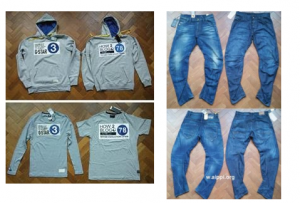
Image source : www.alamy.com/ www.sgcr.pt and www.aippi.org

The Portuguese Court of First Instance ruled in favor of G-Star, recognizing the ARC and ROWDY models as “works,” ordering Cofemel to cease its infringing acts, and directing the disgorgement of profits. Cofemel appealed the judgment to the Tribunal da Relação de Lisboa (Court of Appeal, Lisbon, Portugal), which subsequently affirmed the lower court’s decision.

The case was further appealed to the Supreme Court of Portugal. This apex court acknowledged that G-Star’s designs were the result of a creative design process featuring specific formative elements, and that Cofemel had incorporated several of those elements into its own products. However, the Supreme Court faced a legal dilemma: the Portuguese Copyright Act did not explicitly define the requisite threshold of “originality” for this category of designs, and judicial practice reflected the view that an “aesthetic effect” or “high artistic value” was required to trigger protection.

Consequently, the Supreme Court of Portugal referred a question to the Court of Justice of the European Union (CJEU) for a preliminary ruling in Case C-683/17, seeking clarification on whether Article 2(a) of Directive 2001/29/EC (the InfoSoc Directive) permits a Member State to reserve copyright protection for designs that produce a “specific aesthetic effect,” in addition to the criterion of “originality”.

Overcoming the Territoriality Trap: How FUMARI Blocked a Bad-Faith Trademark Filing in Laos Without Local Registration

[vc_row triangle_shape="no"][vc_column][vc_column_text] Download The Department of Intellectual Property of Laos (“Laos DIP”) recently issued a Notice sustaining an opposition against Trademark Application No. 50354 for “FUMARI” in Class 34, filed by Xuanfeng Biotechnology Sole Co., Ltd. In this matter, KENFOX IP & Law Office represented Fumari Inc. to challenge the adverse party's mark, steering the case to a successful outcome. In its Notice, the Laos DIP confirmed that, following consideration of the opposition based on the relevant reasons and evidence submitted, the opposition was sustained. As a result, the opposed application will not proceed to the substantive examination stage. This is a significant outcome...

Continue reading

Similarity Does Not Necessarily Mean Confusion: What Strategy Can Secure Trademark Protection in the Face of Opposition from a Multinational Group?

[vc_row triangle_shape="no"][vc_column][vc_column_text] Download Being opposed by a major international group is never an encouraging signal for any business seeking protection for its trademark. That pressure becomes particularly acute when the Intellectual Property Office of Vietnam (“IP VIETNAM”), upon examining the matter, issues a notice of intended refusal. From that point onward, the task of protecting one’s rights no longer lies merely in rebutting the opposing party’s arguments; it becomes a matter of persuading IP VIETNAM to reconsider and reverse its own preliminary view - a view that may, to some extent, have been shaped by the intangible influence exerted by globally renowned...

Continue reading

Why Patents “Lose Rights” Upon Entering the Vietnam National Phase: Translation Errors, “New Matter”, and Limitations on Amendments

Download In patent prosecution practice, many applications "fail" - not because the technical solution lacks novelty or an inventive step, but due to the Vietnamese translation at the national phase entry. For patent applications originating from the Patent Cooperation Treaty (PCT) or those claiming priority under the Paris Convention upon entering the national phase in Vietnam, merely a few mistranslated words in the specification or, particularly, the claims, can inadvertently and silently narrow the scope of protection. By the time this is discovered, it is often too late to remedy. The greatest risk lies in the fact that the Vietnamese translation serves...

Continue reading

MEGA MGC COFFEE: A “Reversal” Strategy and Lessons in Trademark Rights Establishment in Vietnam

In Vietnam's trademark registration practice, numerous international brand owners have been forced to withdraw from the market upon facing a critical deadlock: their applications were refused due to conflicts with prior-filed marks. When the likelihood of reversing such a refusal is deemed “very low”, the boundary between successfully introducing a multi-million dollar brand into a new market and leaving empty-handed often hinges solely on a timely strategic decision. The case of MEGA MGC COFFEE - South Korea’s second-largest coffee chain - in Vietnam serves as a compelling illustration of such a turning point. In what initially appeared to be a foregone...

Continue reading

Patent Application Process in Vietnam: A Comprehensive Guide For Chinese Enterprises

Vietnam’s patent system provides multiple avenues to protect technical innovations, ranging from invention patents and utility solutions to industrial designs. This guide, prepared by KENFOX IP & Law Office, a qualified IP Firm in Vietnam, outlines the entire patent application process in Vietnam, including available application routes, types of protection, eligibility criteria, step-by-step procedures, examination and appeal processes, official fees, and strategic considerations. It is tailored for foreign businesses entering Vietnam and focuses on Vietnam’s current laws and practices....

Continue reading

Patent Specification – How a Single Connector Word Can Decide the “Life or Death” of a Patent?

If you believe that the phrase “at least one of A, B, and C” in a patent specification always means “A or B or C”, it may be time to reconsider. In U.S. patent practice, the interpretation of this seemingly simple expression has sparked a debate lasting more than two decades – a debate that remains far from settled today. The controversy originates from the U.S. Court of Appeals for the Federal Circuit’s landmark 2004 decision in SuperGuide Corp. v. DirecTV Enters., Inc. In SuperGuide, the court interpreted the phrase to mean “at least one of A, and at least one...

Continue reading