






Cofemel v. G-Star: The new standard of the European Court of Justice – Can a pair of jeans be considered a “work of art”?
Conventional legal thinking often defaults to the premise that “functional products”—such as a pair of jeans, a pair of sandals, a fashion handbag, or a perfume bottle—fall primarily within the scope of Industrial Design protection. Rights holders rarely consider the mechanism of Copyright, due to the misconception that the form of mass-produced products can hardly meet the threshold of a “work” or a “work of applied art” to warrant protection.
KENFOX IP & Law Office will analyze the case of Cofemel v. G-Star to elucidate how the Court of Justice of the European Union (CJEU) established a new standard in viewing applied designs from a Copyright perspective. The case not only poses the question of whether a pair of jeans—traditionally viewed as a common consumer product—can be recognized as a “work,” but also opens up a broader debate regarding the boundary between utility and creativity. From this, businesses can conceptualize the prerequisites that must be satisfied to determine when a “functional product” can still be protected under copyright law, alongside the industrial design protection mechanism.
1. Background of the incident
G-Star Raw (G-Star Raw CV) is a renowned Dutch fashion company, founded in 1989 in Amsterdam. The brand is globally famous for its denim products (jeans) and its raw, rugged design style. Cofemel (Cofemel – Sociedade de Vestuário SA) is a Portuguese fashion company. It owns the fashion brand Tiffosi, which is highly popular in Portugal and Spain, specializing in the manufacture and trade of ready-to-wear apparel.
In 2013, G-Star Raw initiated legal proceedings against Cofemel, alleging that Cofemel had copied its jeans and t-shirt models named “ARC” and “ROWDY”. The Plaintiff, G-Star, argued that the “ARC” and “ROWDY” models were not merely everyday apparel, but rather the culmination of an intentional, original creative process, thereby qualifying them as “works” eligible for protection under copyright law. Conversely, the Defendant, Cofemel, countered that clothing serves a functional purpose, and such apparel designs cannot be classified as “works” entitled to such protection. Additionally, Cofemel argued that to be eligible for copyright protection, a design must transcend into “art” and possess a specific “aesthetic value” or “artistic effect”.
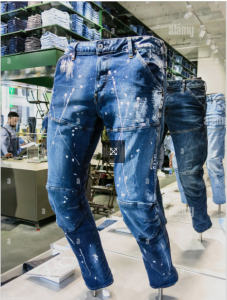
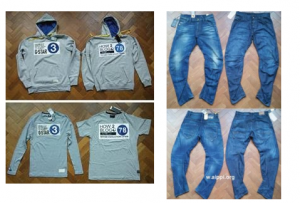
Image source : www.alamy.com/ www.sgcr.pt and www.aippi.org
The Portuguese Court of First Instance ruled in favor of G-Star, recognizing the ARC and ROWDY models as “works,” ordering Cofemel to cease its infringing acts, and directing the disgorgement of profits. Cofemel appealed the judgment to the Tribunal da Relação de Lisboa (Court of Appeal, Lisbon, Portugal), which subsequently affirmed the lower court’s decision.
The case was further appealed to the Supreme Court of Portugal. This apex court acknowledged that G-Star’s designs were the result of a creative design process featuring specific formative elements, and that Cofemel had incorporated several of those elements into its own products. However, the Supreme Court faced a legal dilemma: the Portuguese Copyright Act did not explicitly define the requisite threshold of “originality” for this category of designs, and judicial practice reflected the view that an “aesthetic effect” or “high artistic value” was required to trigger protection.
Consequently, the Supreme Court of Portugal referred a question to the Court of Justice of the European Union (CJEU) for a preliminary ruling in Case C-683/17, seeking clarification on whether Article 2(a) of Directive 2001/29/EC (the InfoSoc Directive) permits a Member State to reserve copyright protection for designs that produce a “specific aesthetic effect,” in addition to the criterion of “originality”.
2. The InfoSoc directive and the gap in the concept of “work”
Article 2(a) of Directive 2001/29/EC (InfoSoc Directive) concerning the right to reproduction obliges States Parties to grant authors “ the exclusive right to permit or prohibit reproduction of their works by any means and in any form .” However, the Directive does not provide a complete definition of the concept of “work.” This legislative silence opens the door to differing national interpretations: Each legal system tends to “define” a work according to its own tradition, particularly for objects that lie on the boundary between art and function, such as fashion design, furniture, and industrial products.
In this context, the CJEU’s task in the Cofemel case was to establish a unified EU-level standard on: (1) When an applied design – such as clothing – can be considered a “work” for copyright protection, and (2) Whether Member States are permitted to add the condition of “aesthetic effect/artistic value” in addition to the criterion of “originality”?
3. CJEU’s Argument and Analysis: G-Star “wins on logic”
The Court of Arbitration for the Exonerated States (CJEU) is not a conventional tribunal, so it cannot simply declare “G-Star wins, Cofemel loses.” The CJEU’s role is to interpret the law , but the content of that interpretation directly impacts the outcome of the dispute. In this case, the CJEU’s entire argument heavily favored G-Star and refuted Cofemel’s reasoning .
3.1. Two opposing approaches
- The Argument of Cofemel (Defendant): Cofemel asserted that to qualify for copyright protection, apparel designs must achieve a specific “artistic value” or “aesthetic effect” sufficient to distinguish them from purely commercial fashion designs. This constitutes an exceedingly high threshold—if accepted by the Court, G-Star would stand virtually no chance, as proving a pair of jeans is “art” in the academic sense is exceptionally onerous.
- The Argument of G-Star (Plaintiff): G-Star adopted an alternative approach: it is sufficient for the design to possess “originality”—meaning it is the author’s own intellectual creation, manifested through free and creative choices. There is no requirement to demonstrate that it is “sublime art,” nor must it achieve any “specific aesthetic effect”.
Therefore, the crux of the dispute before the CJEU centered on whether EU law permits a Member State to require an aesthetic/artistic criterion in addition to “originality”?.
3.2. “Works” is a concept of EU autonomy and unity.
The CJEU affirms that the concept of “work” is an autonomous concept of EU law . Member States may not define it in a way that alters or fragments the scope of protection.
The goal is to ensure (i) consistency in the application of the InfoSoc Directive; (ii) legal security and predictability for authors and businesses exploiting works in multiple EU countries; and (iii) avoiding a “one-size-fits-all” approach that makes copyright law confusing and lacking transparency.
3.3. Two cumulative conditions for something to be considered a “work of art”
Based on previous precedents (Infopaq, Painer, Levola Hengelo…), the CJEU asserts that an object (whether literary, musical, artistic, or applied design such as clothing) is only considered a “work” when it simultaneously meets the following two cumulative conditions :
- Originality: The subject matter must be the author’s own intellectual creation. This requires:
- The author has the space for free and creative choices during the design process;
- The design must bear the author’s “personal imprint,” reflecting their preferences, style, or distinctive approach to form creation;
- If form is determined entirely by technical function, functional requirements, or mandatory constraints, leaving no room for creative choice, then it cannot be considered a “work of art” .
- Identifyability: The protected subject matter must have a form that is sufficiently precise and objectively identifiable so that competent authorities, courts, and third parties can clearly identify the scope of protection.
The CJEU emphasizes that these two conditions are cumulative and complete . If a design meets both originality and identity , it is a “work” under EU law. No other conditions are permitted , such as how beautiful it is, what its artistic value is, or whether it is recognized by the art world.
3.4. Emphatically reject the criterion of “aesthetic effect”.
The key point in the Cofemel ruling is the European Court of Justice’s (CJEU) definitive rejection of the “aesthetic effect” criterion as a condition for recognizing copyright protection. The CJEU points out that:
- The concepts of “beauty,” “aesthetic value,” and “high art” are subjective and change over time, depending on the socio-cultural context and the evaluator.
- This subjectivity contradicts the requirement for certainty and objectivity in defining the scope of protection: if the criterion is “to a certain extent of beauty,” no one can predict with certainty the boundary between what is and is not eligible for protection.
- If countries were allowed to require “significant aesthetic effect” as an independent condition, the consequence would be a country with its own standards , undermining the goal of harmonizing copyright within the EU.
Therefore, the CJEU concluded: “Aesthetic effect” cannot be used as an additional condition for recognizing copyright protection. Simply put: copyright is not a “prize for beauty ,” but a mechanism for protecting the author’s original creation .
Whether a clothing design looks “beautiful,” “impressive,” or “fashionable” is not sufficient to determine its eligibility for protection. The deciding factor is whether it is the result of the author’s free and creative choices, original in nature , or merely a formal solution influenced by functionality and industry trends.
3.5. Consequence: CJEU sides with G-Star’s argument.
Although CJEU did not declare “G-Star the winner,” they stated:
- Completely rejecting Cofemel’s approach (which demands “artistic value/aesthetic effect”).
- G-Star asserts that its position is consistent with EU law: “Originality” is the sole condition for content to be protected.
- The statement asserts that Portugal is not permitted to impose the requirement of “aesthetic effect” as an additional, mandatory threshold for copyright protection.
4. The relationship between copyright and design rights: “Simultaneous” protection but without abuse.
A common concern is: If industrial designs (e.g., clothing, handbags, furniture) can be protected under both design rights and copyright , will this lead to the abuse of “dual protection” (cumulation), distorting the balance of the intellectual property system and causing market distortions? The CJEU asserts:
- EU law allows for simultaneous protection : the same object can be registered as a design and, if it meets the standards, simultaneously be a “work” protected by copyright.
- However, the goals and protectionist logic of the two regimes are different :
- Industrial design rights focus on encouraging investment and innovation in the industrial product sector , with short protection periods based on criteria of novelty and distinctiveness.
- Copyright protects intellectual creation , often for a much longer period, based on the criterion of originality.
Therefore, copyright should not be used as a tool to “indefinitely extend” what should rightfully only be within the short-term protection scope of design. The only way to prevent this abuse is to maintain the standard of “originality” at a substantive level , not to lower or replace it with vague criteria such as “superior aesthetic effect”.
In other words, a clothing design is only protected by copyright if—and only if—it is truly the author’s own unique intellectual creation , and not simply because it is fashionable, attractive, or “better than usual.”
Conclusion
For businesses in the design sector—from fashion and interior design to industrial products—the G-Star Raw v. Cofemel case offers a different perspective, delivering a dual message: a warning but also an opportunity . The warning lies in the fact that if businesses continue to disregard the legal value of “originality” and treat design products merely as consumer goods, they are stripping themselves of a strong and long-term legal protection provided by copyright. The opportunity is that by proactively building and preserving a ” creative footprint “—from initial sketches and design selections to rejected options—businesses will possess a compelling body of evidence to prove that their products are the result of free and creative choices, not a mediocre variation of what already exists on the market, thus gaining an advantage in copyright claims and dispute resolution.
G-Star Raw sues Cofemel This case also provides a benchmark for legal systems outside the EU, including Vietnam, when addressing the question: When does an application design “cross the threshold” to be protected as a copyrighted work, alongside traditional mechanisms such as industrial designs, trademarks, or anti-unfair competition? The case helps Vietnamese lawmakers, courts, and businesses have a clearer and more consistent frame of reference in protecting creative value in the design industries.
With 15 years of operation and a solid position in the field of Intellectual Property, KENFOX IP & Law Office has partnered with thousands of domestic and international businesses to establish robust legal protection mechanisms. We not only help you establish rights to Designs, Trademarks, and Copyrights, but also provide aggressive enforcement solutions to combat even the most sophisticated acts of copying.
Nguyen Vu Quan| Partner, IP Attorney
Đao Thi Thuy Nga| Senior Patent Attorney
Nguyen The Kim Anh| Patent Executive
Related Articles:
- Opposing an Industrial Design Application in Vietnam: What secrets to Successful Opposition?
- New product launch: How to keep your product design from being “stolen”?
- Industrial Design Related Matters in Vietnam
- Industrial design protection for products under the Hague System – Key to business success in Vietnam
- To register or to lose, a costly lesson from a typical industrial design dispute in Vietnam
- Provisional rights to patents and industrial designs in Vietnam – What you need to know?
- Industrial Design Or Copyright Protection, Which You May Be Unaware Of?
- What are Key Considerations for Industrial Design Divisional Application in Vietnam?
- Copyright – a powerful and effective weapon to repress trademark and industrial design infringements in Vietnam
- 10 Key Points from Vietnam’s New IP Decree No. 65/2023/ND-CP
- Handling intellectual property rights infringement in Vietnam: Which measures are effective?
- Difference between Copyright and Industrial Design Right
- Amendments to patent and industrial design regulations under the draft of the amended Intellectual Property Law