






Whether Functional Products Are Eligible for Protection as ‘Works of Applied Art’ in Vietnam?
A “functional product”, in simple terms, is a product that serves a practical utilitarian purpose (e.g., household items, electronic devices, technical tools, etc.). For many years, prevailing “orthodox” legal thinking in Vietnam has tended to classify functional products (useful articles) such as bicycles, furniture, handbags, perfume bottles, and coffee machines squarely within the realm of industrial designs. From this practice emerged an almost unassailable assumption: Functional products cannot qualify as “works” and therefore are not eligible for copyright protection.
International practice, however, demonstrates the opposite. French courts have recognized the Hermès Birkin and Kelly handbags as works of art rather than merely functional fashion products. Likewise, the Court of Justice of the European Union (CJEU), in Brompton Bicycle and Cofemel, has affirmed that the shape of a product may constitute a subject matter of copyright protection where it reflects the designer’s “free and creative choices”, notwithstanding the functional elements inherent in such products.
Against the backdrop of a growing number of enterprises and investors in Vietnam creating functional product designs, a critical question arises: can such designs be protected by copyright as “works of applied art” in Vietnam? Article 6.8 of Decree No. 17/2023/ND-CP marks a significant turning point in Vietnam’s legal thinking by clarifying that not all useful articles are excluded from the scope of copyright protection. On the contrary, many products traditionally regarded as falling exclusively within the domain of industrial design may now enter the sphere of copyright protection in the form of works of applied art.
KENFOX IP & Law Office analyzes the relevant provisions of Vietnamese law to address the following question: at what point does a functional product cross the boundary of a purely utilitarian object and become a “work” under Vietnamese copyright law?
1. What Constitutes a Work of Applied Art under Vietnamese Law?
To determine whether products such as bicycles, furniture, handbags, perfume bottles, or coffee machines may qualify as subject matter of copyright protection, it is necessary to examine the relevant definitions and legal bases under Vietnamese law. The primary legal grounds are Article 14.1(g) of the Law on Intellectual Property (Categories of works protected by copyright), as further elaborated in Article 6.8 of Decree No. 17/2023/ND-CP.
“Article 6.8 – Categories of works protected by copyright: 8. Works of applied art as prescribed in point (g), clause 1, Article 14 of the Law on Intellectual Property are works expressed by lines, colors, shapes, and composition, incorporating utilitarian features, which may be embodied in or attached to a useful article, and which are produced either manually or industrially, including: graphic design (forms of expression of logos, visual identity systems, and product packaging; forms of expression of characters); fashion design; aesthetically oriented designs embodied in product shapes; interior design, decorative interior design, and aesthetically oriented exterior design.
Works of applied art are expressed in the form of aesthetically creative product shapes, are not easily created by a person having average knowledge in the relevant field, and do not include external product shapes that are indispensable for the performance of the product’s function”.
This provision represents one of the most conceptually significant definitions within Vietnam’s copyright law framework, as it plays a pivotal role in shaping the legal approach to the protection of applied art works.
2. When Is a Subject Matter Eligible for Copyright Protection? – The Core Lies in “Originality”
Before delving into the category of “works of applied art,” it is necessary to first clarify a fundamental question: When is any given object considered a “work” eligible for copyright protection? The core lies in “originality”.
Vietnamese law defines a “work” as a creative product in the fields of literature, art, and science, expressed in any medium or material form. Article 14.3 of the Law on Intellectual Property (“IP Law”) prescribes: “Protected works […] must be products of intellectual creation directly created by the author through his/her own intellectual labor, without copying from others’ works.”
Although the IP Law does not explicitly employ the term “originality”, the substance of this concept has been formalized and clarified under Article 66.2 of Decree No. 17/2023/ND-CP. This regulation stipulates that, when examining elements of infringement, the competent authority must assess “the originality of the work’s creation and the expression of the idea, not the idea itself”.
From this, it is evident that Originality is the core criterion for establishing the existence and scope of copyright protection. A work is only eligible for protection if it simultaneously satisfies the following essential characteristics:
- It is the result of the author’s free creative choices;
- It demonstrates a personal stamp, reflecting a distinct creative style;
- It is not solely dictated by technical constraints or functional requirements; and
- It transcends shapes and layouts that are commonplace or standard within the industry.
An overarching principle is the distinction between “ideas” and “expression”: Ideas, solutions, functions, or technical rules are not protected; only the specific, creative manner of expression by the author constitutes the subject matter of copyright. Article 66 of Decree No. 17/2023/ND-CP has incorporated this principle into the Vietnamese legal system, aligning it with EU standards and international practice.
Regarding functional products, the critical question is: Where does the creativity lie? Vietnamese law – consistent with international approaches – establishes a crucial boundary:
- Features of shape that are dictated entirely by function, technical standards, or mandatory technical solutions fall outside the scope of copyright protection;
- Aesthetic elements that demonstrate free choice and the author’s personal stamp may be protected as works of applied art, provided they meet the threshold of originality.
It is precisely upon this foundation of “originality” that the identification of whether a functional product design qualifies as a “work of applied art” gains a solid theoretical basis.
- Product features whose shapes are entirely determined by function, technical standards, or mandatory technical solutions fall outside the scope of copyright protection;
- Aesthetic elements that embody free creative choices and the author’s personal imprint may be protected as works of applied art, provided that the threshold of originality is met.
It is precisely upon this conceptual foundation of originality that a sound legal basis exists for determining whether a functional product design qualifies as a “work of applied art” under Vietnamese law.
3. Five Core Legal Criteria for Identifying an “Applied Art Work”
From the above definition, five core legal criteria can be derived for identifying an applied artwork under Vietnamese law:
(i) Form of Expression: Lines, Colors, Shapes, and Composition
An applied art work, even when embodied in a useful article, must possess a visual form expressed through artistic elements such as lines, colors, three-dimensional shapes, and overall composition.
(ii) Functional Connection: Associated with a Utilitarian Function or Useful Article
This is a turning point: The law recognizes that aesthetics and functionality can coexist in the same object. A useful product, a functional product, is no longer automatically excluded from the scope of artwork protection.
(iii) Mode of Production: Handmade or Industrially Manufactured
Applied art works are not confined to traditional fine art. They may also encompass designs created in the context of commercial production and mass manufacturing. The fact that a product is produced industrially does not negate its status as a copyrightable work, provided that its appearance results from the designer’s creative choices rather than from technical standards or manufacturing requirements alone”.
(iv) Creativity: Exceeding “What Would Be Easily Created by a Person of Ordinary Skill”
This requirement reflects Vietnam’s adaptation of the originality standard. A work must be the result of the author’s free and creative choices rather than an obvious or commonplace design that a person with average knowledge in the relevant field could readily produce.
In practice, “originality” is often identified through the author’s “personal creative imprint,” expressed through the following elements:
- The selection and arrangement of visual elements (layout and composition);
- Creative treatment of lines, proportions, colors, and forms;
- Design choices that are not entirely dictated by technical specifications, manufacturing constraints, or functional requirements.
Even where certain technical limitations exist, originality may still be present if the designer retains sufficient creative freedom to express a personal artistic vision.
(v) Excluding purely functional elements: Excluding external forms that are mandatory to perform the product’s function
Elements entirely dominated by function – for example, screw threads, gear teeth, the distinctive “mouth” of a technical detail – will be excluded from copyright protection. Copyright cannot become a barrier to technical competition. In other words, the artistic expression must have a certain degree of independence from its functional use: If the function is removed, the remaining design still has its own aesthetic value. For example, the dragon and phoenix motifs on a ceramic vase do not help the vase retain water better; they exist as an aesthetic expression independent of its water-holding function. Thus, copyright does not protect the entire product, but only its aesthetic expression, independent of functional optimization.
The five criteria mentioned above show that current law no longer automatically excludes functional products from copyright protection. The new regulations therefore break down the rigid division between industrial designs and works of art, paving the way for the protection of product designs with aesthetic value.
4. “Lines – Colors – Shapes – Composition”: A System of Criteria Expanding the Scope of Protection
Vietnamese law defines the elements of form – lines, colors, shapes, and composition – as components that can be protected. Notably, “shape” is understood to include the entire three-dimensional form of the product, not just surface decorative patterns. At the same time, the phrase “associated with useful function” acknowledges that applied art works can be the tangible part of a functional product (e.g., handbags, bicycles, perfume bottles, table lamps, coffee makers). Therefore, if a useful product is expressed through lines, colors, shapes, and composition that are aesthetically pleasing – and that form is not entirely dominated by functional requirements – then in principle it can be classified as an applied art work and protected by copyright.
Importantly, this regulation removes the rigid limitation that all “functional products” fall solely within the scope of industrial design.
5. Expanded Scope: From “Lines” to “Product Design”
Notably, the definition of applied art works in Article 6.8 of Decree 17/2023/ND-CP includes the phrase “artistic design associated with product design”—a deliberate expression intended to encompass a group of creative objects that lie between art and industry. This is a crucial legislative technique, allowing Vietnamese law to expand the scope of protection to functional products that also possess aesthetic design elements, from furniture, bicycles, and handbags to perfume bottles and coffee makers.
Because lawmakers cannot list all types of useful products in daily life, the concept of “artistic design associated with product form” is used as an open concept to identify the aesthetic expression on any product with a form. This means that: if a useful item has a form expressed through lines, colors, shapes, and composition that are aesthetically pleasing, not entirely dominated by function, and demonstrate a certain degree of creativity, then theoretically, that expression can be considered for protection as an applied art work.
However, this should not be interpreted to mean that every aesthetically pleasing design of a functional product is protected. Article 6.8 simultaneously establishes two important limitations:
- excluding the form that is mandatory for the product to perform its function; and
- requiring that the artistic expression cannot be easily reproduced by a person of average knowledge in the relevant field.
These two limitations truly ensure that only the independent aesthetic element, bearing a genuine creative imprint, falls within the scope of copyright protection.
Examples:
- Chair: A chair can be protected as an applied art work only for its aesthetic expression, such as the handling of curves, the composition of decorative shapes, or unique design features not determined by the technical requirements for the chair to perform its seating function. If this design demonstrates a certain level of creativity and cannot be easily reproduced by a person of average knowledge in interior design or industrial design, then that part may be considered for copyright protection.
- Handbag: A product that serves both a functional purpose of carrying and possesses significant aesthetic creative space. According to Article 6.8, only the artistic elements – such as surface treatments, decorative patterns, line composition, and unique shapes – that are not dictated by the need for carrying items or bearing weight, are subject to copyright protection.
Fashion brands like Hermès and Chanel… often have creative processes expressed through sketches, line selection, color schemes, and decorative composition – these are independent aesthetic elements that can be considered for protection if they cannot be easily created by someone with average knowledge in fashion design.
In some international cases involving Hermès Birkin or Kelly bags, foreign courts have recognized that the aesthetic elements of these bags go beyond purely functional needs and can reach the level of works of art. However, this does not mean that the entire shape of the bag – which is influenced by its functional purpose – will be protected under Vietnamese law. Therefore, handbags can be protected as applied art works, but only for their independent aesthetic aspects, not the entire structure or functional shape of the bag.
- Perfume bottles, water bottles: These products typically offer significant opportunities for artistic creativity. Elements such as the curvature of the bottle body, proportions, color schemes, glass effects, and decorative compositions are generally not dictated by the function of containing liquids and often reflect the designer’s artistic choices. Such aesthetic features may qualify for protection as applied art works if they satisfy the requirement that they could not be readily created by a person with ordinary knowledge in packaging design or industrial design.
However, functional components – such as bottle openings, caps, spray mechanisms, neck structures, or flat bases required for stability – remain outside the scope of copyright protection. Only those aesthetic elements that extend beyond the minimum technical requirements of the product may qualify.
- Bicycles and Coffee Machines: Bicycles and coffee machines are highly functional products, and much of their external appearance is dictated by engineering requirements, structural considerations, operating mechanisms, and component placement. Under Article 6.8, these purely functional features are not eligible for copyright protection.
However, this does not mean that all aspects of design are excluded. If the product has elements that are aesthetically independent – such as decorative details, patterns, surface treatments, color schemes, or curves unrelated to functionality – these elements may be protected as applied art, provided they could not have been easily created by someone with average knowledge in industrial design.
The CJEU’s decision in Brompton Bicycle illustrates this principle. Although the bicycle frame was heavily influenced by technical considerations, the Court recognized that a designer may still enjoy a degree of creative freedom. Where design choices reflect artistic considerations rather than being solely dictated by function, the resulting expression may be eligible for copyright protection.
Accordingly, Article 6.8 adopts a broad and flexible approach to defining applied art works, encompassing graphic design, fashion design, artistic designs embodied in product shapes, and artistic interior and exterior designs. The provision reflects the recognition that useful products are not merely functional objects; they may also constitute copyrightable works when their visual appearance embodies independent aesthetic creativity distinct from their utilitarian purpose. This approach is consistent with contemporary international trends that seek to distinguish clearly between technical functionality and artistic expression in copyright protection.
6. Why Should Functional Products Be Considered for Registration as “Applied Art Works”?
In an increasingly competitive marketplace characterized by growing risks of imitation and unauthorized copying, businesses are adopting multi-layered intellectual property protection strategies, combining copyright, industrial design rights, and trademarks. Within this framework, registering the aesthetic aspects of functional products as applied art works can provide significant legal advantages, particularly where the protected elements constitute independent artistic expression that is not dictated solely by utilitarian considerations and reflects the designer’s creative individuality.
- A Strong Legal Basis for Enforcement Against Infringing Goods: Article 66.4 of Decree 17/2023/ND-CP stipulates that products created from copyright infringement are considered infringing goods. This means that if the aesthetic representation of a protected design is illegally copied and affixed to goods, not only is the act of copying prosecuted, but the entire product bearing that copied element is considered infringing. This mechanism expands enforcement capabilities, allowing authorities to seize, destroy, or penalize based on the infringing goods themselves, not just on the act of copying.
- Requests for removal of online infringements become more feasible and effective: In the context of the booming e-commerce, social networks, and intermediary platforms (Shopee, Lazada, TikTok Shop, Facebook, Instagram, Google, etc.), a significant advantage of registering applied art works is the ability to apply the mechanism for removing infringing content as stipulated in Article 114 of Decree 17/2023/ND-CP.
If a business designs a backpack with creative and aesthetically pleasing decorative patterns and obtains a copyright registration certificate, the business has the right to request intermediary platforms (e-commerce platforms, social networks, content hosting services, etc.) to remove infringing product images when: (i) a third party illegally uses the protected backpack design image; or (ii) they copy those aesthetic patterns and attach them to their goods for advertising and sale..
According to Article 114, intermediary businesses are required to temporarily remove the images within 72 hours of receiving a valid request accompanied by evidence proving ownership.
Without a copyright registration certificate, proving ownership to request removal is almost impossible according to legal procedures, depriving the rights holder of a quick, powerful, and effective enforcement tool.
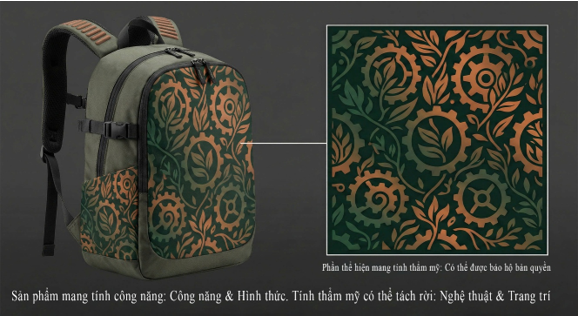
- Flexible scope and protection standards: Applied art works are protected by copyright based on the originality of their aesthetic expression, rather than requiring “absolute novelty” and “inventiveness” as with industrial designs. Therefore, businesses can still obtain copyright protection even if the design has already been published and no longer meets the conditions for design protection. This is a significant advantage in practice, especially for businesses launching products before registering the industrial design. However, the scope of protection is limited to the independent aesthetic aspect, excluding design elements influenced by the product’s functionality.
- Superior protection period: Property rights for applied art works are protected for 75 years from the date of publication or 100 years from the date of creation if not published, much longer than the maximum 15-year term of industrial design patents. This is particularly significant for products with long lifecycles or symbolic value.
- An effective supplementary and contingency solution: Registering for protection as an applied art work provides a parallel and independent protection mechanism compared to industrial design. Protection as an applied art work is therefore a strategic escape: focusing on protecting the creative element, allowing protection even when the design has been published and is no longer novel in terms of style.
Conclusion
The introduction of Article 6.8 of Decree No. 17/2023/ND-CP marks a significant evolution in Vietnamese copyright law. Rather than automatically confining useful products to the realm of industrial design protection, Vietnamese law now recognizes that functional products may embody independent aesthetic creativity and therefore qualify for protection as applied art works. This development offers several practical benefits:
- Encourages innovation by recognizing the aesthetic value of product design;
- Expanding the range of intellectual property tools available to businesses by enabling the combined use of copyright, industrial design rights, and trademarks;
- Providing a valuable alternative where industrial design registration is unavailable due to loss of novelty, since copyright protection is based on originality and offers a substantially longer term of protection; and
- Strengthening anti-copying measures by facilitating enforcement against products that unlawfully reproduce protected artistic designs.
In short, when a useful product possesses a unique aesthetic imprint, it can be considered a work of art, not just an object. The new regulations therefore open up great opportunities for design investment, protecting creative value and enhancing their competitiveness.
QUAN, Nguyen Vu | Partner, IP Attorney
PHAN, Do Thi | Special Counsel
HONG, Hoang Thi Tuyet | Senior Trademark Attorney
Related Articles:
- Trademark Application & Registration Process: A Comprehensive Guide For Foreign Enterprises in Vietnam
- Cancelling a Trademark Registration in Bad Faith in Vietnam: What a Genuine Trademark Owner Needs to Do?
- Similarity Does Not Necessarily Mean Confusion: What Strategy Can Secure Trademark Protection in the Face of Opposition from a Multinational Group?
- Registering a Trademark in Bad Faith in Vietnam: How to Prove the Applicant’s Intentions and Motives
- Trade Name Rights Defeat Trademark Squatting: LChau Pharmaceutical Company Keeps Its Brand and the Squatter Loses Registration in Court
- “Bad Faith”, “Conflict of Rights”, and “IP Abuse” in Vietnam: What Lessons Can Be Drawn from the “Foellie” Trademark Dispute?
- Resolving Disputes Between Trade Names and Trademarks in Vietnam: How to Proceed?
- Bad faith (Malicious) – a legal basis for trademark opposition or invalidation in Vietnam
- Invalidating a bad-faith trademark registration in Vietnam
- HAICNEAL vs. HAINOZAL: Stopping a Copycat Shampoo Line, Forcing Destruction of Labels and Printing Equipment, and Blocking a Trademark Hijacking
- What strategies to reclaim unregistered trademark rights in Vietnam?