




Assessing Copyright Infringement of Applied Art Works in Vietnam: Scope of Protection and Determination Principles
In practice, when handling copyright disputes concerning works of applied art, a frequently asked question is: Does the mere resemblance between two works of applied art constitute infringement? This resemblance may stem from the initial visual impression that the two works have the same form. However, this subjective impression can easily lead to prejudice and cause the assessment to deviate from the true nature and scope of protection of the applied art work.
So where does the scope of protection for a work of applied art lie? When does a work of applied art fall within the scope of protection of a protected work of applied art? Or more precisely, what elements of the work are protected?
To answer these questions, it is necessary to return to the core principles of the Intellectual Property Law, Decree 17/2023/ND-CP, and the nature of “works of applied art” within the copyright system.
1. Scope of copyright protection for works of applied art: “Lines – colors – shapes – composition” are central to copyright protection.
According to Article 66.2 of Decree 17/2023/ND-CP, the scope of copyright protection is determined based on:
- The original form of expression of the work (not an abstract idea)
- The originality of creativity
- The expression or manifestation of an idea, but not the idea itself.
This means that the scope of copyright protection is determined by the original form of expression of the work; determining infringement must consider the originality of the creation and expression, not the pure idea. To conclude infringement, a copy must be compared with the original in terms of form of expression, originality, time of completion, and accessibility of the original work.
This provision plays an important role in distinguishing between: (i) Similarity in general ideas (not constituting infringement): Multiple works may share a common design idea (e.g., geometric patterns, traditional ethnic motifs) and (ii) Similarity in specific expression (potentially constituting infringement): When layout, lines, decorative details, proportions, etc., are copied.
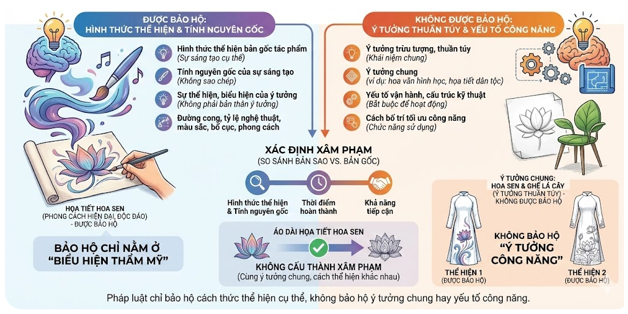
For example: If two designers create the same lotus flower motif on an ao dai (Vietnamese traditional dress), but one draws the lotus in a modern style with minimalist lines, and the other in a classical style with many intricate details → this does not constitute infringement because the methods of expression are different.
This means that the law does not protect ideas (such as the idea of designing a chair in the shape of a leaf), but only protects the specific way in which that idea is expressed (lines, proportions, decorative details, colors, layout, etc.).
Thus, the protected elements may include: aesthetic curves, artistic proportions, color schemes, unique shapes, compositional layouts, and design styles. Elements such as: external parts essential for product operation, technical structures, layouts for optimal functionality, and other essential elements for product operation are not protected. => Protection is limited to “aesthetic expression,” not “functional concept.”
SCOPE OF COPYRIGHT PROTECTION: AESTHETIC EXPRESSION VS. FUNCTIONAL IDEAS
(According to Article 66.2 of Decree 17/2023/ND-CP)
2. Principles for Assessing Infringement of Works of Applied Art.
Article 66 of Decree 17/2023/ND-CP stipulates that: “The basis for determining copyright infringement is the scope of copyright protection determined by the form of expression of the original work; the originality and expression of the idea, not the idea itself, must be considered.”
Therefore, the infringement analysis in relation to works of applied art is carried out based on the following three principles:
[i] Comparison by form of expression: Instead of comparing general ideas, compare specific expressive elements (color, composition, lines, imagery, way of expressing character, aesthetic details) to determine if there is overlap in expression/expression.
Note: Comparisons should be based on the concrete manifestation and expression of the creative idea, not the idea itself. For example:
- ❌ Not protected by copyright: The idea of a packaging design featuring a lotus flower”
- ✓ Protected: Specific instructions on how to draw a lotus flower (lines, proportions, perspective, colors, stylistic techniques).
[ii] Assessment of originality: Article 66 requires consideration of:
- “The originality of the work’s creation”
- “The expression of the creative idea behind the work”
This means: (i) Not every part of the work is protected and (ii) Only that part representing creative choice, not subject to function, and not intended for public dissemination, is within the scope of protection.
Therefore, when comparing infringements, it is necessary to determine:
(i) The part of the work that is original → is the protected part.
(ii) Did the other party copy this original part? → If yes, → infringement.
(ii) The level of copying does not need to be high → only need to copy an original expression, not requiring copying many parts.
An element is only protected if it is the result of independent creation and bears a personal imprint; common elements and techniques are not protected. Originality is the deciding criterion when comparing. Elements that ARE original (and are protected) may include:
- The selection, arrangement, and combination of elements reflect the author’s personal creative choices.
- The style of expression is unique and different from other works.
- The patterns and images are original creations and not copied from public sources.
- Characteristic styling techniques (variations, simplifications, stylistic changes, etc.)
- The aesthetic details bear the author’s unique mark.
For example: Both of these ao dai designs use lotus flower motifs:
- Artwork A: A minimalist drawing of a lotus flower, with five equally sized petals, sharp vector lines, pastel pink color, and symmetrical arrangement on both sides.
- Artwork B: A lotus flower painted in the ink wash style, with uneven petals, soft and diluted brushstrokes, a gradient of light and dark pink, and a natural, off-center arrangement.
Conclusion: Although sharing the same idea of “lotus flowers on the ao dai,” the expressions are clearly different, each work possessing its own originality → No infringement is considered.
[iii] Access and timing: It is necessary to demonstrate that the alleged infringer had access to the original work and the time of its completion to rule out the possibility of accidental coincidence or independent creation.
(a) Assess whether the alleged infringer had access to the original work:
Evidence demonstrating accessibility:
- The original work has been published, exhibited, and released.
- The defendant had previously attended the event where the artwork was exhibited.
- The work is publicly available on the internet and social media.
- The defendant had previously worked with and collaborated with the original author.
- The defendant had previously been sent and shown the original work.
- The original work is famous in the industry; it’s hard not to know it.
In cases where access is unavailable:
- The original work has never been published.
- The defendant lives in a remote location and lacks access.
- No evidence of access.
If accessibility cannot be proven, even if there is similarity, it is difficult to conclude infringement (it could be a coincidence of independent creation).
(b) Compare the time and date of completion of the work:
Evidence regarding the time period:
- Date of copyright registration and deposit
- Date of first publication
- Metadata of digital files (creation date, modification date)
- Contracts and invoices related to the creative process.
- Emails and messages exchanged about the work.
- The draft is dated.
Evaluation principles:
- The work completed earlier is generally in a stronger position to establish authorship.
- If the work is suspected of being completed after the original work was published + there is evidence of access → High likelihood of infringement
If both works were completed at the same time or the order cannot be determined → Other factors need to be considered (level of similarity, accessibility, originality).
Example: Work A was copyrighted on January 1, 2023, and publicly posted on Facebook. Work B appeared on June 1, 2023, and has many similarities to A.
Analysis:
✓ Work A has the advantage in terms of time (5 months earlier)
✓ Work A has been publicly published → Author B has access to it.
✓ If a detailed comparison reveals significant similarities in presentation → High likelihood of infringement, the burden of proof shifts to party B (must prove independent creation).
3. When does infringement occur: copying the entire work or copying only a part of it?
According to points a, b, and c of Clause 3, Article 66 of Decree 17/2023/ND-CP, copies/works are considered infringing in the following cases:
[i] Copying the entire work: This is the easiest case to recognize: copying exactly, without significant changes in form of expression.
[ii] Partial Copying: Key Issues for Consideration
If a work of applied art consists of six parts, and the other party only copies one part (which is also the original work of the author), would this constitute infringement?
(a) Legal basis: According to Article 66.3(a) , it is clearly stated: “A copy is a reproduction of part or all of a protected work” → The law does not require a complete reproduction to constitute infringement.
Point c, Clause 3, Article 66 further expands: “Works, parts of works containing characters, images, ways of expressing character traits, images, or plot details of the protected work” are also considered infringements.
(b) The evaluation criteria were “partially” copied.
Point 1 – Strict requirement: The copied part must be the most aesthetically pleasing , distinctive , and recognizable part of the original work.
Point 2 – Flexibility required: Only the copied portion is needed:
- It is the creative (original) part.
- The source can be identified from the original work.
- It is not a common or widespread factor.
Practical analysis: In the spirit of Decree 17/2023, viewpoint 2 is more consistent with reality and the purpose of copyright protection. Reason:
✓ The law does not distinguish between “most important parts”: The law only refers to “parts” without setting criteria for importance.
✓ Comprehensive copyright protection: Requiring only the “most aesthetically pleasing part” would create loopholes for infringement.
✓ Originality is the deciding criterion: As long as the part represents the author’s original creative work (not a common, public element), copying constitutes infringement.
For example, a packaging design might consist of six elements: (i) Brand logo; (ii) Pattern in the upper left corner (unique and creative); (iii) Main color palette; (iv) Font; (v) Slogan; and (vi) Product image.
If a second party copies the pattern in the upper corner (even if it’s not the most prominent element), but this pattern:
- Uniquely created by the author.
- Not a typical pattern.
- The origin can be identified.
→ It still constitutes infringement, it doesn’t have to be the “most aesthetically pleasing part”.
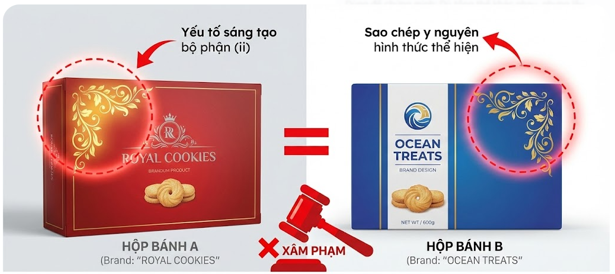
Copying an original part = Copyright infringement
(Despite the overall differences)
(c) How is “partial” copying interpreted and what are the criteria for constituting infringement?
- A part of a work may constitute infringement if that part is creative, possesses independent aesthetic qualities, and falls within the scope of protection of the original work. Not every “part” is sufficient; the creative quality of the copied part must be assessed.
- Practical criteria: When a work consists of six parts, copying one part only constitutes infringement if that part contains an original, easily recognizable element with significant aesthetic value; if the copied part is a secondary element or uses common techniques, it is unlikely to constitute infringement. In other words, copying a part must exceed the “significant” threshold in terms of creativity to be considered infringement.
- The law does not require the copied portion to be the “most aesthetically pleasing part,” but practice proves otherwise, and courts often consider the importance and originality of that part within the overall work when making judgments.
[iii] Copying characters, images, and styles of expression
This is a particularly important regulation for works of applied art. Even if the entire work is not copied, the use of:
- Character, distinctive image
- The way characters’ personalities and images are portrayed.
- Distinctive plot elements
This is also considered an infringement.
For example: A designer creates a unique mascot character for a brand. Even if someone else doesn’t copy the entire packaging design, using that mascot character constitutes infringement.
Conclusion
The principles governing infringement assessment for works of applied art under Decree 17/2023/ND-CP has established a clear and scientific legal basis and principles. The scope of protection does not lie in the general idea or visual impression, but in the specific original form of expression.
Determining infringement must be based on a comparison of specific expression and originality, not on preliminary visual impression; partial copying may constitute infringement if that part falls within the scope of protection and is substantially original.
When evaluating a dispute, evidence regarding the completion date, proof of access, expert analysis of the original elements, and a detailed comparison of the manifested elements should be gathered to determine the outcome of the dispute.
With 15 years of experience and a proven reputation in the field of Intellectual Property, KENFOX IP & Law Office understands the legal challenges in protecting and enforcing design rights. We not only assist businesses in establishing and registering industrial design and copyright rights, but also develop in-depth consulting and litigation strategies, focusing on identifying, isolating, and proving the “core creative elements” – the key factors determining the scope of protection, infringement criteria, and enforcement effectiveness. This ensures optimal protection of design assets and increases the probability of success in complex infringement disputes.
QUAN, Nguyen Vu | Partner, IP Attorney
PHAN, Do Thi | Special Counsel
HONG, Hoang Thi Tuyet | Senior Trademark Attorney
Related Articles:
- Beyond First-to-File: How Copyright Won a Trademark Battle in Vietnam?
- Bad-Faith Trademark Filings in Vietnam: What’s new in the IP Law 2025?
- How to Overcome Trademark Refusal for Genericness or Descriptiveness in Myanmar?
- Trademark Refusal in Vietnam: What Strategy Enabled the “Three-Circle” Mark to Overcome a Likelihood-of-Confusion Objection?
- Cancelling a Trademark Registration in Bad Faith in Vietnam: What a Genuine Trademark Owner Needs to Do?
- Trademark Examination Processes in Vietnam: Why You Need to Monitor Every Step to Avoid Costly Delays
- Addressing IP disputes in Vietnam: Declarations of non-infringement and invalidity
- “Bad Faith”, “Conflict of Rights”, and “IP Abuse” in Vietnam: What Lessons Can Be Drawn from the “Foellie” Trademark Dispute?
- Trademark Use in Vietnam: How to Correctly Understand and Effectively Rebut Non-Use Cancellation Attacks
- “Bad Faith”, “Conflict of Rights”, and “IP Abuse” in Vietnam: What Lessons Can Be Drawn from the “Foellie” Trademark Dispute?