



KENFOX IP & Law Office > Trademark in Vietnam

Trademark Refusal in Vietnam: What Strategy Enabled the “Three-Circle” Mark to Overcome a Likelihood-of-Confusion Objection?

[vc_row triangle_shape="no"][vc_column][vc_column_text]Download When two figurative marks with nearly identical structural compositions are filed for the same category of goods, the prospects of securing registration for the later-filed application are generally slim. In other words, the risk of refusal is exceptionally high. Many businesses assume that obtaining a Letter of Consent from the owner of the cited mark will automatically resolve the issue. In practice, however, the matter is far more complex. A Letter of Consent is an important supporting piece of evidence, but it is not a legally binding instrument that compels acceptance by the trademark authority. Examiners remain fully entitled...

Continue reading
Bad-Faith Trademark Filings in Vietnam: What’s new in the IP Law 2025?

[vc_row triangle_shape="no"][vc_column][vc_column_text]Download Vietnam’s first-to-file trademark system has increasingly been exploited by professional trademark squatters. In practice, certain individuals and companies have filed dozens, or even hundreds, of trademarks that appear to copy or imitate marks already used by foreign brand owners, overseas manufacturers, franchise chains, online sellers, or businesses preparing to enter Vietnam. These filings are often not made for genuine commercial use. Rather, they are made to wait for a payoff. Once registered, that mark may be used not only as a passive obstacle to registration, but also as an active commercial weapon: to demand payment, block distribution, pressure local partners,...

Continue reading

Similarity Does Not Necessarily Mean Confusion: What Strategy Can Secure Trademark Protection in the Face of Opposition from a Multinational Group?

[vc_row triangle_shape="no"][vc_column][vc_column_text] Download Being opposed by a major international group is never an encouraging signal for any business seeking protection for its trademark. That pressure becomes particularly acute when the Intellectual Property Office of Vietnam (“IP VIETNAM”), upon examining the matter, issues a notice of intended refusal. From that point onward, the task of protecting one’s rights no longer lies merely in rebutting the opposing party’s arguments; it becomes a matter of persuading IP VIETNAM to reconsider and reverse its own preliminary view - a view that may, to some extent, have been shaped by the intangible influence exerted by globally renowned...

Continue reading

Cassation Protest in the Binh Minh Plastics Case: Restoring the Value of Expert Evidence in Trademark Dispute Resolution

Download On March 9, 2026, the intellectual property (IP) dispute between Binh Minh Plastics Joint Stock Company and Binh Minh Viet Plastics Joint Stock Company marked a significant procedural turning point: the Supreme People's Procuracy officially issued a Cassation Protest. This decision recommends the annulment of both the first-instance judgment of the People's Court of Ho Chi Minh City and the appellate judgment of the High People's Court in Ho Chi Minh City. Over the past period, this case has been considered a typical "bottleneck," exposing the unpredictability and latent risks within Vietnam's IP litigation system. Previously, despite holding the most robust...

Continue reading

MEGA MGC COFFEE: A “Reversal” Strategy and Lessons in Trademark Rights Establishment in Vietnam

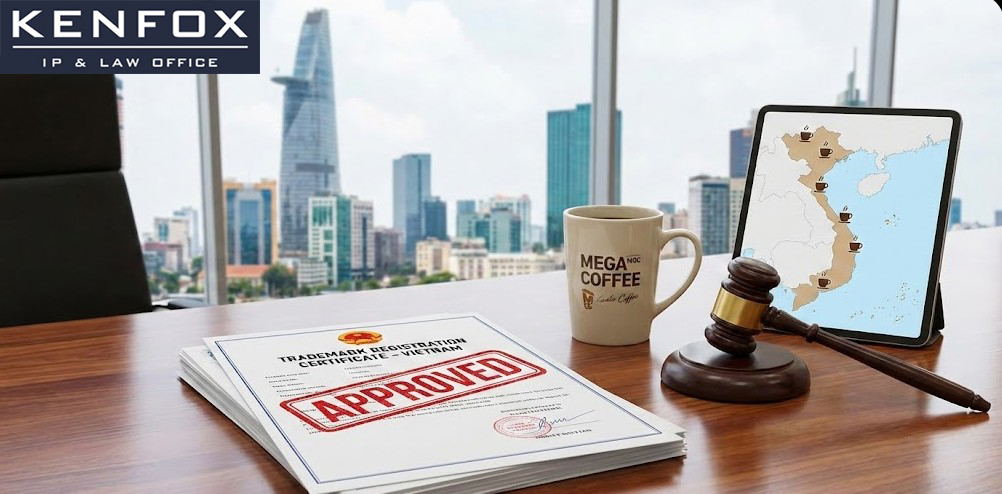
In Vietnam's trademark registration practice, numerous international brand owners have been forced to withdraw from the market upon facing a critical deadlock: their applications were refused due to conflicts with prior-filed marks. When the likelihood of reversing such a refusal is deemed “very low”, the boundary between successfully introducing a multi-million dollar brand into a new market and leaving empty-handed often hinges solely on a timely strategic decision. The case of MEGA MGC COFFEE - South Korea’s second-largest coffee chain - in Vietnam serves as a compelling illustration of such a turning point. In what initially appeared to be a foregone...

Continue reading

Lacoste: Disrupting Wholesale Counterfeit Supply in Hanoi’s Old Quarter – 1,073 Items Seized, Factory-Scale Source Neutralized, Administrative Fine Imposed

KENFOX IP & Law Office represented Lacoste in a coordinated anti-counterfeiting action targeting two apparel shops in Hanoi’s Old Quarter that, following pre-raid investigation, were confirmed to be operating as upstream wholesalers of counterfeit Lacoste garments. After compiling evidence that these locations were supplying fake “LACOSTE” and crocodile-logo apparel into the broader Hanoi retail network, we escalated the case to the Inspectorate of the Ministry of Science & Technology (IMOST) for administrative enforcement. IMOST conducted raids on the identified premises, seizing 1,073 counterfeit garments and imposing administrative fines totaling VND 183,360,000 on the two wholesalers. The seized inventory was ordered...

Continue reading

Trademarks in the Metaverse: How to Effectively Protect Trademarks for “Physical” Products in the Virtual Space in Vietnam?

Trademark disputes are becoming increasingly diverse, complex, and unceasing. Does the owner of a trademark for a “physical” automobile or watch, protected in Vietnam, China, or any other country, have the right to prevent a "virtual" version of the same product from appearing in an online game - with its logo intact and players willing to spend real money to acquire it? In a broader sense: Can using a mark on a virtual goods infringe the trademark for a physical goods? Traditionally, trademark infringement has been assessed based on the likelihood of confusion, in which the similarity between goods or...

Continue reading

Addressing IP disputes in Vietnam: Declarations of non-infringement and invalidity

Intellectual property disputes, especially those concerning trademarks, are an inevitable part of the dynamic business environment in Vietnam. Instead of passively waiting for the threat of trademark disputes to arise, wise businesses will seek proactive solutions to protect themselves. The question then becomes: how can businesses proactively "stay one step ahead", mitigate legal risks, and confidently explore the market? Declarations of non-infringement and trademark invalidity are two excellent legal mechanisms, empowering third parties to definitively establish legal "boundaries", create a "safe harbor" for their commercial activities....

Continue reading

At a glance: Trademark Opposition in Vietnam

In Vietnam, a trademark opposition is a legal procedure that allows a third party to formally challenge a pending trademark application before it gets officially registered by the Intellectual Property Office of Vietnam (VNIPO, formerly, NOIP). A trademark opposition aims at preventing the registration of trademarks that could potentially infringe on existing rights or create confusion in the marketplace. It's a proactive measure to avoid future legal disputes and brand damage....

Continue reading